Label printing guide
Direct Thermal vs Thermal Transfer – Which Label Printing Method Should You Choose?
Choosing between direct thermal printing and thermal transfer printing affects label durability, barcode readability, print quality, running costs and long-term reliability.
This guide helps you choose the right method for shipping labels, product labels, warehouse labels and industrial labels.
Quick answer: Direct thermal printing is best for short-term labels, while thermal transfer printing is the better choice for durable labels that must withstand handling, storage, moisture, heat or chemicals.
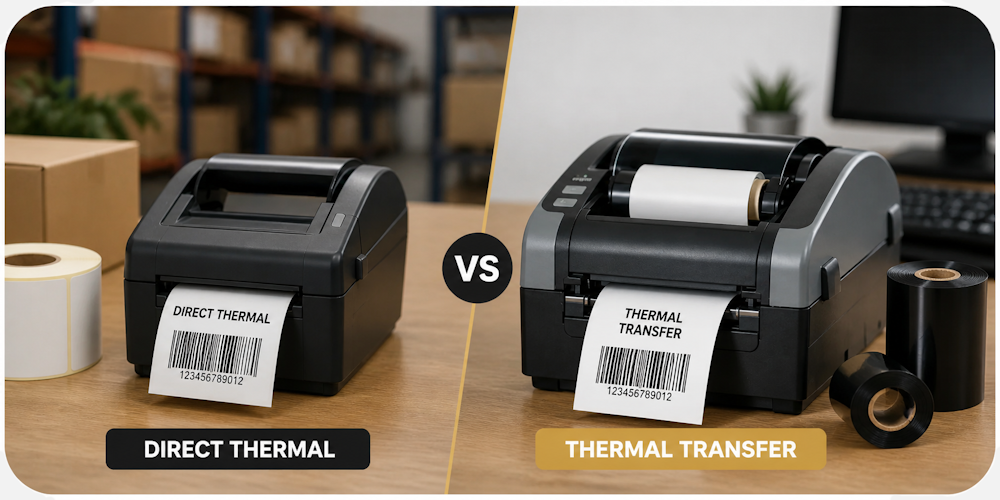
Direct thermal vs thermal transfer printing
Direct thermal label printing uses heat-sensitive label material and does not require a ribbon. It is simple, cost-effective and ideal for labels with a shorter lifespan. Thermal transfer label printing uses a ribbon to transfer print onto the label surface, creating a more durable and resistant result.
When to use direct thermal labels
- Shipping labels and transport labels
- Receipts and short-term identification
- Temporary warehouse labels
- Labels used indoors for a limited time
When to use thermal transfer labels
- Product labels and barcode labels
- Warehouse labels and shelf labels
- Industrial labelling applications
- Labels exposed to handling, moisture, sunlight or chemicals
Label printers and barcode quality
The right label printer and label material help ensure sharp print quality and reliable scanning with barcode scanners.
Which label printing method should you choose?
If your labels only need to last for a short period, direct thermal printing is often the most efficient and cost-effective solution. If you need long-lasting labels that remain readable over time, especially in logistics, warehousing or industrial environments, thermal transfer printing is the more reliable choice.
Need help choosing the right label printing method?
Explore our label printers or contact us for advice.
Email: info@streckkodscenter.se
Phone: +46 (0)31-27 42 30