- Unbeatable prices all year round
- Flat-rate shipping on many products.
- +46 (0)31-27 42 30
- info@streckkodscenter.se

Labels for Warehouse, Shipping and Industrial Use
Choosing the right labels for warehouse, shipping and industry improves barcode readability, traceability, stock control and operational efficiency.
This guide explains how to choose the right label material, adhesive and print method for logistics, transport, inventory management and demanding industrial environments.
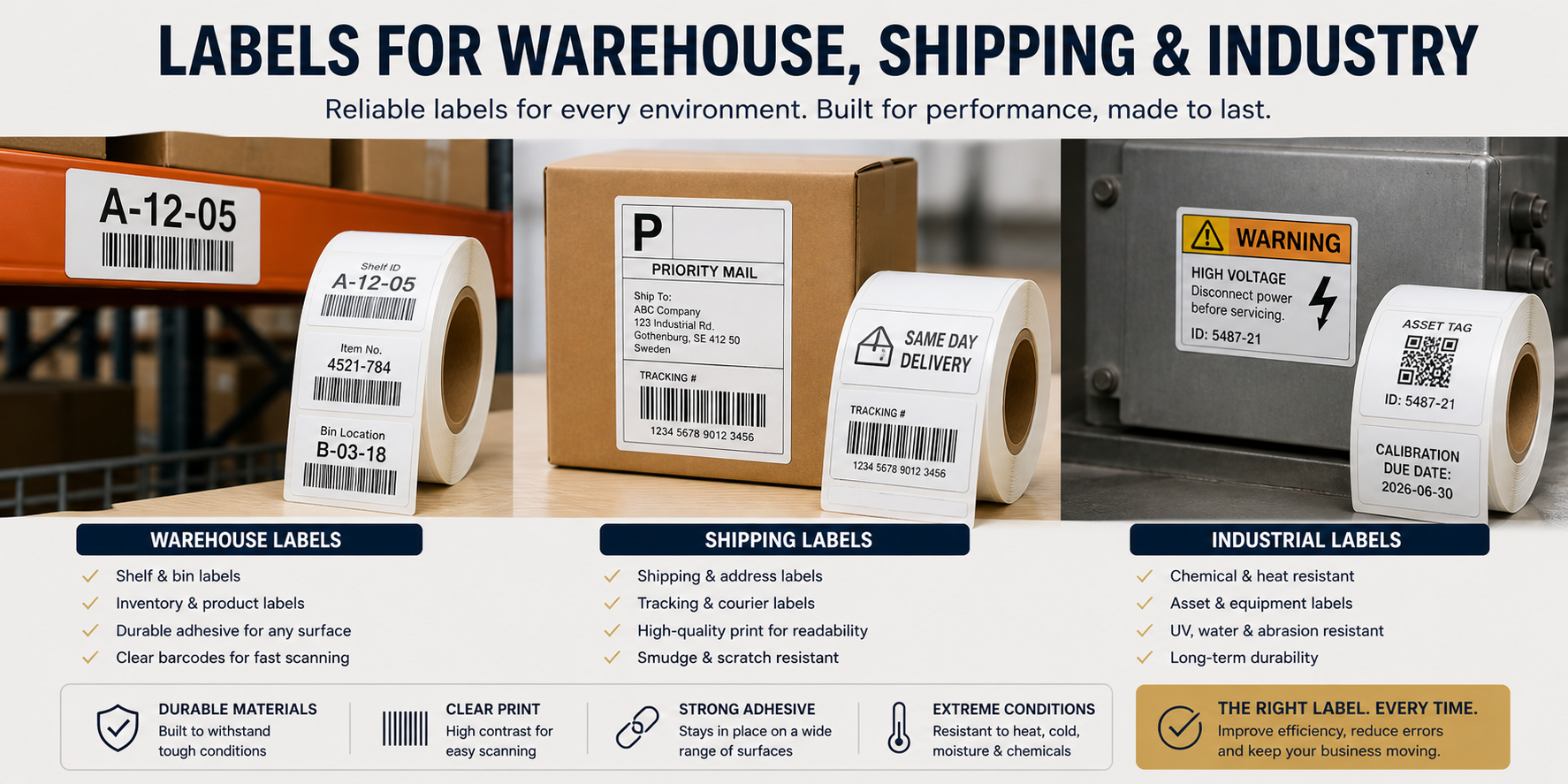
Quick answer: Paper labels are suitable for shipping and short-term use. Synthetic labels are recommended for warehouse, logistics and industrial applications where durability, moisture resistance and long-term barcode readability are important.
Why the right labels matter
Labels play a key role in barcode scanning, inventory control, shipping accuracy, traceability and daily workflow. In warehouses, labels must be easy to scan. In shipping, they must stay readable throughout transport. In industrial environments, they must withstand demanding conditions.
The wrong label material can lead to fading, peeling, damaged barcodes, scanning errors, lost goods and unnecessary rework.
Warehouse labels
Warehouse labels are used for inventory tracking, shelf identification, pallet handling and location management. They must support fast scanning, clear readability and reliable adhesion during daily handling.
- Barcode labels for stock control
- Shelf labels and rack labels
- Pallet labels and carton labels
- Location labels for warehouse zones
- Picking labels for internal logistics
For long-term warehouse use, synthetic labels such as polypropylene or polyester are often a better choice than standard paper labels.
Shipping labels and transport labels
Shipping labels must remain readable from packing to final delivery. Clear barcodes, strong adhesive and the right label material help reduce scanning problems, delays and incorrect shipments.
- Parcel shipping labels
- Address labels and return labels
- Transport labels for carriers
- Pallet labels for logistics
- Cold chain shipping labels
Direct thermal labels are commonly used for standard shipping because they are simple and cost-effective. For longer durability, thermal transfer labels or synthetic labels are often recommended.
Industrial labels for demanding environments
Industrial labels must often withstand heat, cold, moisture, abrasion, chemicals, outdoor exposure and long-term use. In these applications, label failure can affect traceability, compliance and production flow.
- Asset labels and equipment labels
- Product identification labels
- Component labels
- Outdoor and weather-resistant labels
- Chemical-resistant labels
Synthetic labels combined with thermal transfer printing usually provide the best durability for industrial labeling.
Paper labels vs synthetic labels
The choice between paper labels and synthetic labels depends on the application, environment and required lifespan.
- Paper labels: suitable for shipping, retail, packaging and short-term identification
- Synthetic labels: suitable for warehouse, industry, outdoor use, moisture and long-term identification
Explore our range of labels and label materials for warehouse, shipping and industrial applications.
Choose the right print method
The label material should match the printing technology. Direct thermal printing is often used for short-term shipping labels, while thermal transfer printing is better for durable barcode labels and long-term identification.
For synthetic labels, the correct ribbon and printer combination is important for high-quality print, barcode readability and long-lasting results. See our selection of label printers and thermal transfer ribbons.
Barcode readability and scanning
Clear label print quality improves scanning accuracy and daily workflow. For reliable reading in warehouse, retail and logistics environments, use labels that work well with your barcode scanners.
How to choose the right label
- Decide how long the label must remain readable
- Check exposure to moisture, cold, heat or sunlight
- Choose the right adhesive for the surface
- Consider barcode scanning frequency
- Select paper or synthetic material based on durability needs
- Match the label with the correct print method
- Calculate total cost, not only purchase price
Common mistakes when choosing labels
Many companies choose labels based only on price. This can result in unreadable barcodes, peeling labels, reprinting, scanning issues and workflow disruptions.
Another common mistake is ignoring the real environment. Cold, heat, moisture, friction, chemicals and outdoor exposure can quickly make the wrong label material fail.
FAQ – Warehouse, shipping and industrial labels
What labels are best for warehouse use?
Synthetic barcode labels are often best for long-term warehouse use because they provide better durability, adhesion and readability than standard paper labels.
Are direct thermal labels good for shipping?
Yes. Direct thermal labels are widely used for standard shipping labels because they are cost-effective and suitable for short-term transport use.
What labels last the longest?
Synthetic labels printed with thermal transfer usually offer the longest lifespan and the best resistance to moisture, chemicals, abrasion and demanding environments.
Need help choosing the right labels?
Contact Streckkods-Center for advice on labels for warehouse, shipping, logistics and industrial use.
Email: info@streckkodscenter.se
Phone: +46 (0)31-27 42 30