- Unbeatable prices all year round
- Flat-rate shipping on many products.
- +46 (0)31-27 42 30
- info@streckkodscenter.se
How to Choose a Barcode Scanner for Business Use
Choosing the right barcode scanner improves workflow efficiency, scanning accuracy and inventory management across retail, warehouse, logistics and industrial environments.
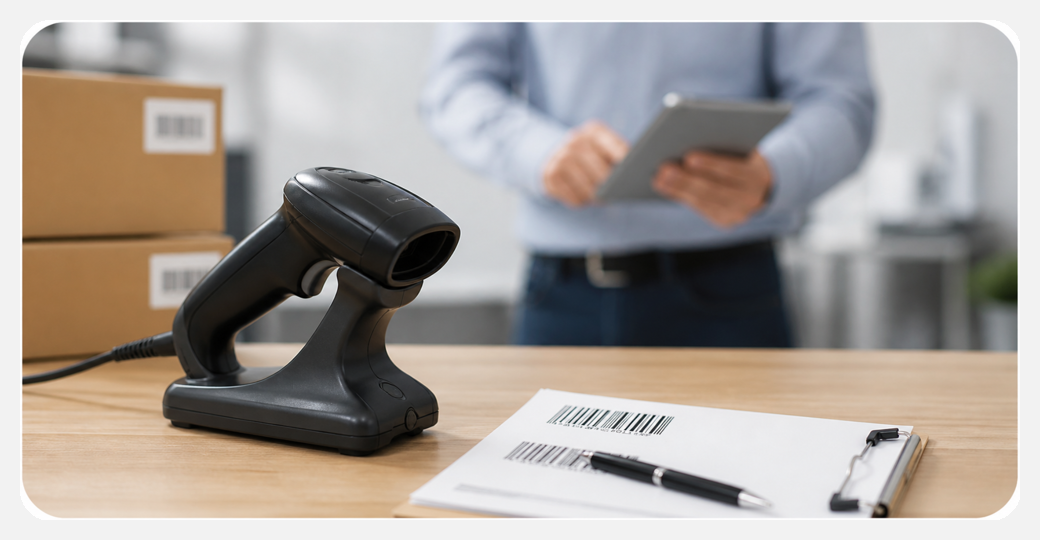
Warehouse and Logistics
Quick tip: A modern 2D barcode scanner is usually the best long-term investment because it supports both traditional barcodes and QR codes.
What is a barcode scanner?
A barcode scanner captures barcode data quickly and accurately to support product registration, inventory management, order processing and shipping operations.
Barcode scanners are widely used in retail POS systems, warehouse management, logistics, industrial traceability and manufacturing environments.
Businesses use barcode technology to reduce manual errors, improve inventory accuracy and increase workflow speed across the supply chain.
1D vs 2D barcode scanners
A 1D barcode scanner reads traditional linear barcodes such as EAN, UPC and Code 128.
A 2D barcode scanner can read both traditional 1D barcodes and advanced formats such as QR codes and Data Matrix.
Most businesses today choose 2D scanners because they provide better future flexibility and support mobile screen scanning.
| Feature | 1D Scanner | 2D Scanner |
|---|---|---|
| Traditional barcodes | ✔ | ✔ |
| QR codes | ✖ | ✔ |
| Mobile screen scanning | ✖ | ✔ |
| Future flexibility | Limited | High |
Wireless vs wired barcode scanners
Wired barcode scanners provide stable performance for fixed POS systems and packing stations.
Wireless barcode scanners improve mobility and flexibility in warehouse, retail and logistics environments.
Bluetooth barcode scanners are especially popular because they reduce cable clutter and improve ergonomics.
Industrial barcode scanners
Industrial barcode scanners are designed for demanding environments with dust, vibration, moisture and heavy daily use.
Many rugged barcode scanners can read damaged or low-contrast labels commonly found in warehouses and manufacturing.
Barcode scanners for warehouse and logistics
Warehouse barcode scanners are often used together with mobile computers and warehouse management systems for picking, packing and inventory control.
Real-time barcode scanning improves traceability, inventory visibility and operational efficiency.
Labels and print quality
High-quality barcode labels and reliable label printers are essential for accurate barcode scanning.
Poor print quality can lead to scanning errors, delays and reduced productivity.
Common mistakes when choosing a barcode scanner
- Choosing only based on price
- Buying a 1D scanner instead of a future-proof 2D scanner
- Ignoring scanning distance requirements
- Using poor-quality barcode labels
- Not checking software compatibility
FAQ – Barcode scanners
For most businesses, a 2D barcode scanner is the best long-term choice because it supports both traditional barcodes and QR codes.
Yes. A 2D barcode scanner can read both traditional 1D barcodes and modern 2D barcode formats.
Wireless industrial barcode scanners and mobile computers are commonly recommended for warehouse workflows.
Need help choosing the right barcode scanner?
Contact Streckkods-Center for expert advice on barcode scanners for retail, warehouse, logistics and industrial environments.
Email: info@streckkodscenter.se
Phone: +46 (0)31-27 42 30