- Unbeatable prices all year round
- Flat-rate shipping on many products.
- +46 (0)31-27 42 30
- info@streckkodscenter.se
What is RFID Technology?
RFID technology is used to identify, track and manage items wirelessly using radio frequency signals. It is widely used in warehouses, logistics, retail, manufacturing, asset tracking and inventory management.
RFID systems can improve visibility, reduce manual scanning, speed up inventory processes and create more efficient workflows across the supply chain.
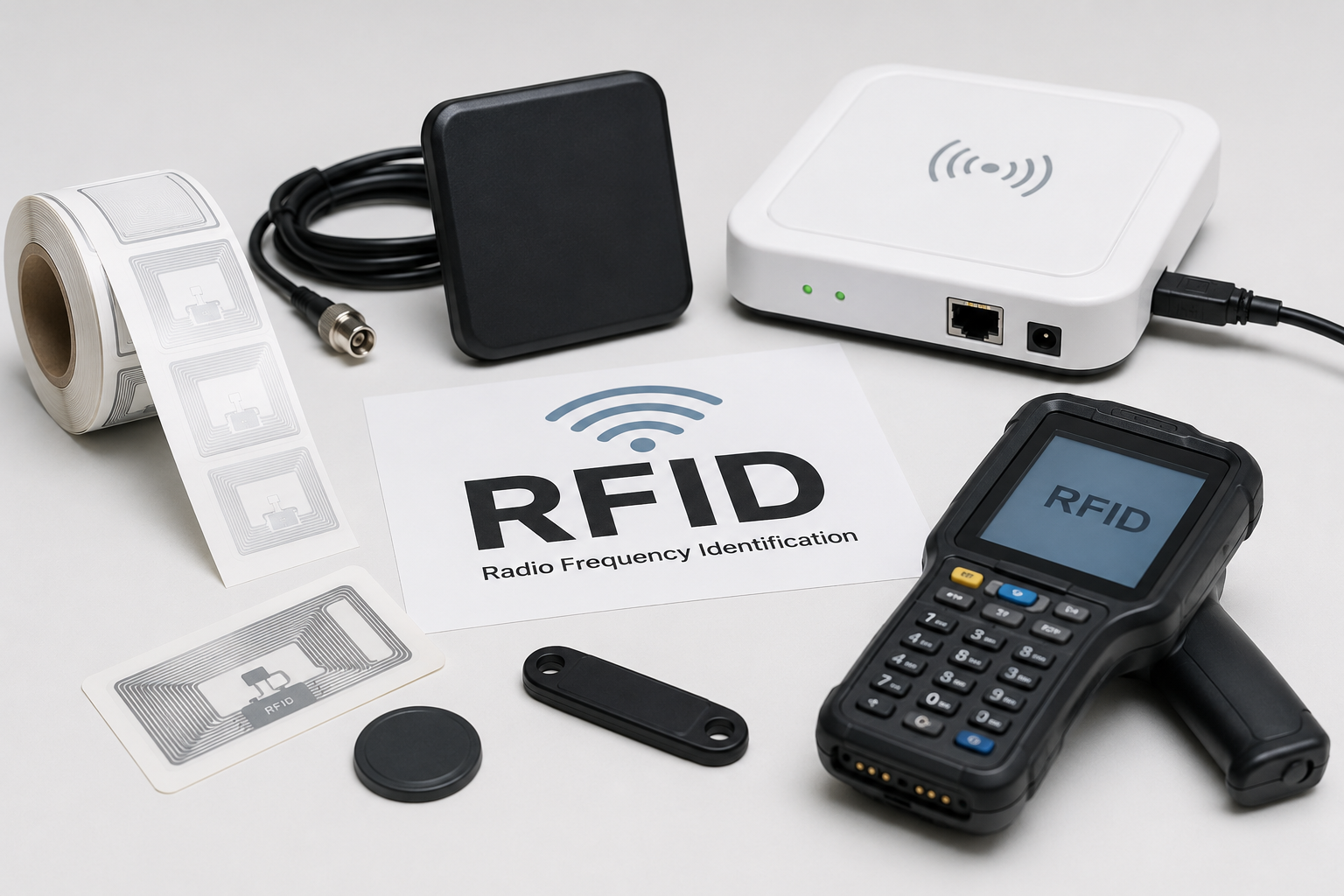
Quick answer: RFID stands for Radio Frequency Identification. It uses RFID tags, readers and antennas to identify objects wirelessly without direct line-of-sight scanning. RFID is often used for inventory control, asset tracking, warehouse management and logistics.
What is RFID?
RFID, or Radio Frequency Identification, is a technology that uses radio waves to identify and communicate with tagged objects. An RFID tag contains information that can be read by an RFID reader, often without the need to scan each item individually.
Unlike traditional barcode scanning, RFID does not always require a visible code or direct line of sight. This makes RFID useful when many items need to be identified quickly, or when products are stored in boxes, pallets, containers or difficult-to-reach locations.
How does RFID work?
An RFID system normally consists of an RFID tag, an RFID reader, an antenna and software that processes the data. The reader sends a radio signal through the antenna. When an RFID tag enters the reading area, it responds with stored information such as an item number, serial number or unique identification code.
The information is then sent to a business system, warehouse management system, inventory platform or asset tracking software. This allows companies to track goods, equipment and assets automatically.
Main components of an RFID system
| Component | Purpose |
| RFID tag | Stores the item identity or data |
| RFID reader | Reads data from RFID tags |
| RFID antenna | Sends and receives radio signals |
| RFID software | Processes, filters and sends data to business systems |
Types of RFID tags
RFID tags are available in different types depending on the application, reading distance, environment and required durability. The most common types are passive RFID, active RFID and semi-passive RFID.
- Passive RFID tags: do not have their own battery and are powered by the reader signal.
- Active RFID tags: include a battery and can support longer reading distances.
- Semi-passive RFID tags: use a battery for internal functions but still communicate through the reader signal.
RFID frequencies
RFID systems use different frequency ranges depending on the application. The choice of frequency affects reading distance, speed, tag design and how well the system works around materials such as metal or liquids.
- LF RFID: often used for access control and animal identification.
- HF RFID: common in cards, libraries, NFC applications and item identification.
- UHF RFID: widely used in warehouses, retail, logistics and supply chain tracking.
RFID vs barcode technology
| Feature | RFID | Barcode |
| Line of sight | Not always required | Required |
| Multiple items | Can read many tags quickly | Normally scanned one by one |
| Cost per label/tag | Usually higher | Usually lower |
| Best use | Automation, tracking and bulk reading | Simple identification and low-cost labelling |
Benefits of RFID technology
- Faster inventory counting
- No need for direct line-of-sight scanning in many applications
- Improved asset tracking and traceability
- Better visibility across warehouse and logistics workflows
- Reduced manual scanning and administration
- Support for automation and real-time data collection
- Improved control of products, tools, equipment and returnable assets
Common RFID applications
RFID technology is used in many industries where fast identification, tracking and automation are important. It can be used alone or together with barcode technology depending on the workflow.
- Warehouse management: track pallets, cartons, locations and inventory.
- Retail: improve stock visibility, item tracking and store operations.
- Manufacturing: track work-in-progress, components and production assets.
- Logistics: follow goods through transport, loading and distribution.
- Asset tracking: manage tools, equipment, returnable containers and IT assets.
- Healthcare: identify equipment, supplies and critical assets.
Choosing the right RFID solution
The right RFID solution depends on what you want to track, where the items are used and how the data should be connected to your existing systems. Reading distance, tag type, frequency, environment and software integration are important factors.
For many businesses, the best approach is to start with a clear process analysis. Identify where manual scanning is slow, where inventory accuracy is low and where RFID could improve visibility or automation.
RFID and barcode technology together
RFID does not always replace barcodes. In many businesses, RFID and barcode technology work together. Barcodes remain cost-effective for simple labelling, while RFID is useful for faster reading, automation and tracking without direct scanning.
A complete identification solution may include barcode scanners, label printers, barcode labels, RFID readers, RFID tags and warehouse software.
FAQ – RFID technology
What does RFID stand for?
RFID stands for Radio Frequency Identification. It is a technology used to identify and track objects wirelessly using radio signals.
What is RFID used for?
RFID is used for inventory management, asset tracking, warehouse automation, retail stock control, logistics, manufacturing and supply chain visibility.
Is RFID better than barcodes?
RFID is better for fast reading, automation and tracking without direct line-of-sight. Barcodes are usually better for simple, low-cost product identification.
Can RFID be used in warehouses?
Yes. RFID is commonly used in warehouses to track pallets, cartons, products, returnable assets, locations and inventory movements.
Need help with RFID or barcode solutions?
Contact Streckkods-Center for advice on RFID technology, barcode scanners, label printers, labels and identification solutions for your business.
Email: info@streckkodscenter.se
Phone: +46 (0)31-27 42 30