- Unbeatable prices all year round
- Flat-rate shipping on many products.
- +46 (0)31-27 42 30
- info@streckkodscenter.se

Shipping and Transport Labels Guide
Shipping and transport labels are essential for accurate deliveries, barcode scanning, traceability and efficient logistics operations.
This guide explains how shipping labels work, what information they should contain and how to choose the right label material and print method for warehousing, transport and distribution.
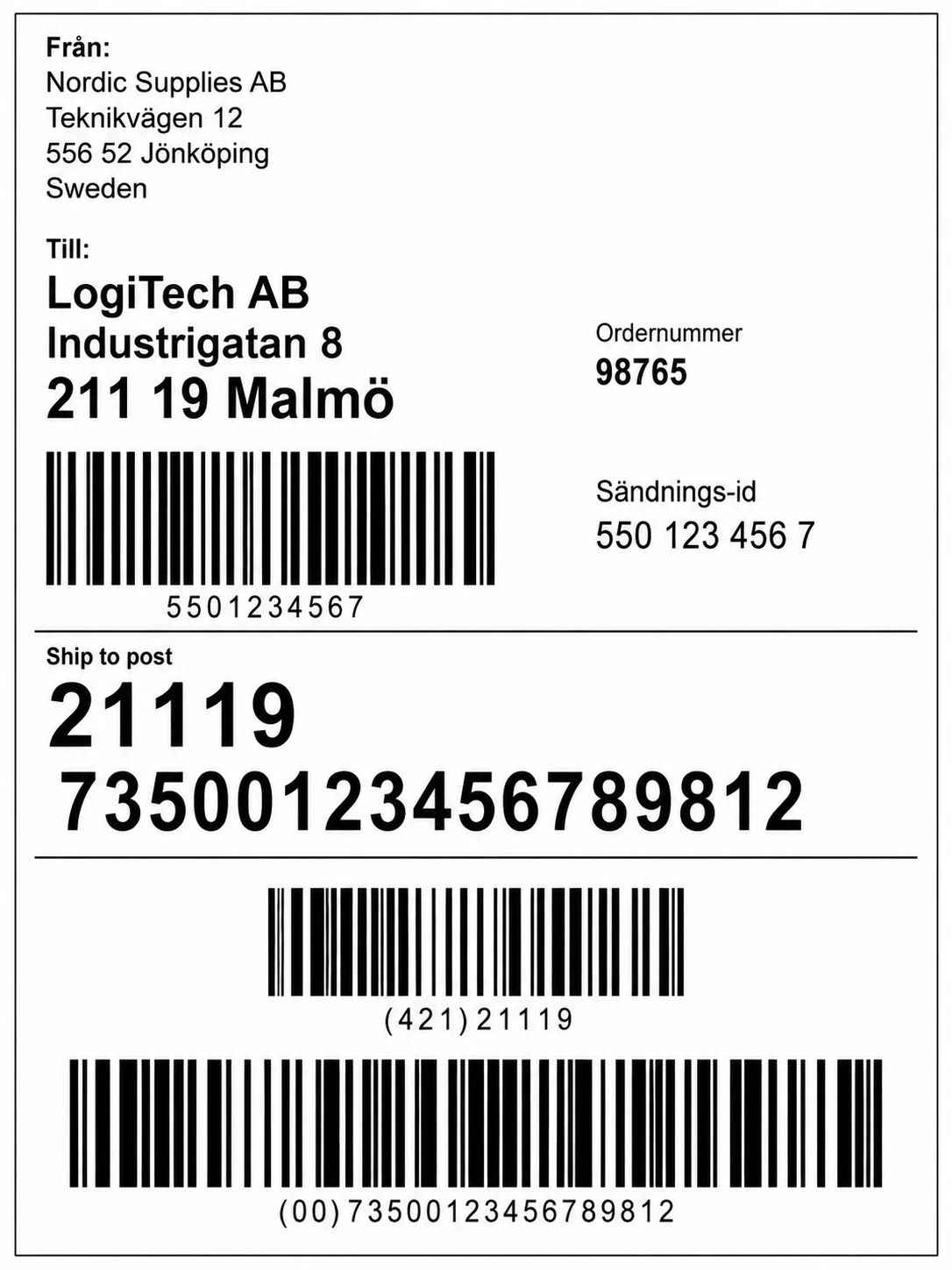
Quick answer: Shipping labels should include clear barcode data, delivery information, carrier references and readable text. For transport and logistics, the label must remain scannable throughout handling, sorting, storage and delivery.
What are shipping and transport labels?
Shipping and transport labels are printed labels used to identify parcels, pallets, cartons and shipments during logistics handling. They normally contain barcode data, delivery details, sender information, carrier references and human-readable text.
These labels connect the physical shipment with digital systems such as warehouse management systems, transport management systems, carrier platforms and barcode scanning solutions.
Why shipping labels are important
A clear and durable shipping label helps goods move through the supply chain without delays. If a barcode cannot be scanned or a label becomes unreadable, shipments may be delayed, misplaced or returned.
- Improves barcode scanning during sorting and delivery
- Reduces shipping errors and manual handling
- Supports traceability across the supply chain
- Helps carriers identify parcels and pallets quickly
- Improves warehouse and dispatch efficiency
- Reduces the risk of damaged or unreadable shipment data
Types of transport labels
Different logistics processes require different label types. A parcel shipment may only need a standard address and barcode label, while pallet shipments may require larger labels with more detailed transport and traceability data.
- Parcel shipping labels
- Address labels and return labels
- Pallet transport labels
- Carrier labels
- Warehouse dispatch labels
- Cold chain transport labels
- Logistics barcode labels
Shipping labels for parcels and pallets
Parcel labels are commonly used for e-commerce, retail distribution and standard carrier shipments. They must be easy to scan and stay attached during sorting, loading, transport and delivery.
Pallet labels are often larger and may include SSCC codes, batch information, product data, shipment references and destination details. For more information, see our guide to pallet labeling in the knowledge base.
What should a shipping label include?
The exact content depends on the carrier, shipment type and business process. However, most shipping and transport labels include a combination of barcode data and readable shipment information.
- Recipient name and delivery address
- Sender information
- Tracking number
- Carrier barcode
- Shipment reference or order number
- Service type or delivery method
- Return information
- Handling instructions when needed
Barcode requirements for transport labels
Barcode quality is critical for shipping labels. The barcode must have enough contrast, correct size and clear print quality to be scanned quickly by warehouse staff, sorting systems and delivery carriers.
- Use high contrast between barcode and background
- Avoid wrinkles, damage and label distortion
- Use the correct barcode size for the scanning distance
- Keep the quiet zone around the barcode clear
- Use a suitable printer resolution for the label format
- Test scanning before large-scale shipping
For reliable scanning, combine high-quality transport labels with suitable barcode scanners.
Direct thermal vs thermal transfer labels
Direct thermal labels are widely used for standard shipping because they are simple, fast and cost-effective. They do not require a ribbon, which makes them practical for parcel shipping and short-term transport use.
Thermal transfer labels are recommended when labels need better resistance to moisture, heat, friction or longer storage times. This method uses a ribbon and can provide more durable barcode printing.
See our range of label printers and thermal transfer ribbons for reliable shipping and logistics labeling.
Choosing the right transport label material
The best transport label material depends on the shipping environment, handling conditions and how long the label must remain readable. Standard paper labels are suitable for many parcel shipments, while synthetic materials are better for demanding logistics environments.
- Paper labels: suitable for standard parcels and short-term shipping
- Synthetic labels: better for moisture, cold, abrasion and long transport chains
- Strong adhesive labels: useful for cartons, pallets and shrink wrap
- Removable labels: useful when labels must be removed without residue
- Thermal transfer labels: recommended for durable barcode readability
Explore our range of labels and label materials for shipping, transport and logistics.
Labels for cold chain and demanding transport
Some shipments are exposed to cold, moisture, condensation, rough handling or long transport routes. In these cases, standard paper labels may not be enough.
For cold chain, industrial transport or outdoor handling, synthetic label materials and thermal transfer printing are often better choices. They help keep barcodes readable and labels attached throughout the logistics process.
Common shipping label mistakes
Many shipping problems are caused by poor label quality, wrong placement or labels that are not suitable for the transport environment.
- Using labels with weak adhesive
- Placing labels across edges or uneven surfaces
- Printing barcodes with poor contrast
- Using direct thermal labels for long-term exposure
- Covering barcodes with tape or stretch film
- Using labels that are too small for the required data
- Not testing barcode readability before dispatch
Best practices for shipping and transport labels
- Choose the correct label material for the transport environment
- Use strong adhesive for cartons, pallets and shrink wrap
- Keep barcodes clean, flat and easy to scan
- Use thermal transfer printing for durable labels
- Place labels on visible and accessible surfaces
- Match label size with carrier and system requirements
- Use reliable printers and high-quality consumables
FAQ – Shipping and Transport Labels
What is a shipping label?
A shipping label is a printed label used to identify a parcel, pallet or shipment. It usually includes delivery information, tracking data, barcode information and carrier references.
What information should a transport label include?
A transport label should include recipient details, sender information, tracking number, barcode, shipment reference and any required carrier or handling information.
Are direct thermal labels suitable for shipping?
Yes. Direct thermal labels are commonly used for standard parcel shipping and short-term transport because they are simple, fast and cost-effective.
Which labels are best for long-distance transport?
For long-distance transport, synthetic labels or thermal transfer labels are often recommended because they offer better durability, adhesion and barcode readability.
Looking for more information?
Visit our Label Printer Knowledge Base for more guides about thermal printing, shipping labels, warehouse labelling, barcode printers, QR codes and printer comparisons.
Need help with shipping labels?
Contact Streckkods-Center for advice on shipping labels, transport labels, barcode labels, label printers and logistics labeling solutions.
Email: info@streckkodscenter.se
Phone: +46 (0)31-27 42 30