- Unbeatable prices all year round
- Flat-rate shipping on many products.
- +46 (0)31-27 42 30
- info@streckkodscenter.se

RFID vs. Barcodes
RFID and barcodes are two of the most common technologies for identification, inventory management, asset tracking and warehouse control.
Both technologies help businesses track products and assets, but they work in different ways and are best suited for different applications.
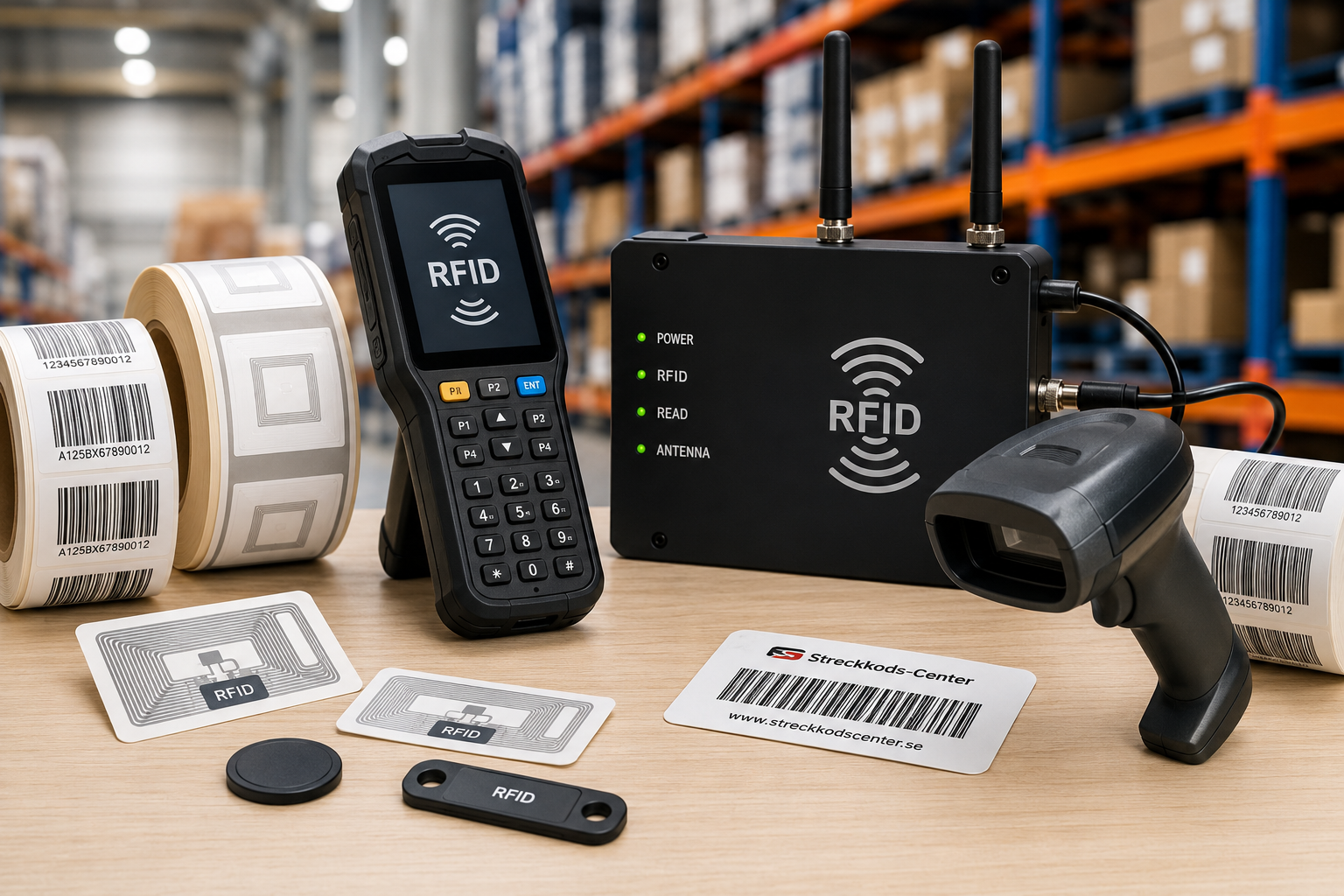
Quick answer: Barcodes are simple, low-cost and ideal for product identification, while RFID is better for wireless reading, automation, bulk scanning and asset tracking. Many businesses use both technologies together.
What is RFID?
RFID stands for Radio Frequency Identification. It uses radio waves to identify and track items fitted with RFID tags. An RFID system usually includes RFID tags, RFID readers, antennas and software.
RFID does not always require direct line-of-sight. This means an RFID reader can often detect tags through packaging, inside boxes or from a distance, depending on the system and environment.
What are barcodes?
Barcodes are printed codes that store information in a visual format. They are scanned with barcode scanners or mobile computers and are widely used in retail, logistics, warehouses, healthcare and manufacturing.
Barcode technology is reliable, affordable and easy to implement. Common examples include 1D barcodes, 2D codes, QR codes, GS1 codes and Data Matrix codes.
RFID vs barcode comparison
| Feature | RFID | Barcodes |
| Reading method | Radio frequency | Optical scanning |
| Line of sight | Not always required | Required |
| Multiple item reading | Yes | Usually one at a time |
| Cost per label/tag | Higher | Lower |
| Best for | Automation, asset tracking and bulk reading | Product labelling and low-cost identification |
Advantages of RFID
- Can read multiple tags quickly
- Does not always require direct line-of-sight
- Useful for automation and fast inventory counting
- Good for asset tracking and returnable assets
- Can improve visibility across warehouse and logistics workflows
- Suitable for pallets, containers, tools, equipment and high-value goods
Advantages of barcodes
- Low cost per label
- Easy to print and implement
- Works with many systems and scanners
- Excellent for product identification and retail
- Reliable for shipping labels, warehouse locations and inventory control
- Ideal when each item is scanned individually
When should you choose RFID?
RFID is a strong choice when speed, automation and visibility are important. It is useful when many items need to be identified quickly, when direct scanning is difficult or when assets must be tracked across several locations.
Common RFID applications include warehouse automation, asset tracking, pallet tracking, retail inventory, manufacturing, logistics and supply chain visibility.
When should you choose barcodes?
Barcodes are often the best choice when you need a simple, affordable and proven identification method. They are widely used for product labels, shelf labels, shipping labels, inventory labels and retail checkout.
For many companies, barcode labels combined with barcode scanners, label printers and barcode labels provide the most cost-effective solution.
Can RFID and barcodes work together?
Yes. RFID and barcode technology are often used together. Barcodes are excellent for simple visual identification, while RFID can support automation, bulk reading and tracking without direct scanning.
A warehouse may use barcodes for product labels and shipping labels, while RFID is used for pallets, returnable transport items, tools or high-value assets. The right solution depends on the workflow, environment and budget.
FAQ – RFID vs barcodes
Is RFID better than barcodes?
RFID is better for automation, bulk reading and tracking without direct line-of-sight. Barcodes are better for low-cost product identification and simple scanning workflows.
Is RFID more expensive than barcodes?
Yes. RFID tags and readers are usually more expensive than barcode labels and barcode scanners. However, RFID can save time in workflows where many items must be read quickly.
Can RFID replace barcodes?
In some applications RFID can replace barcodes, but in many businesses the two technologies work best together. Barcodes remain very cost-effective for product and shipping labels.
Which is best for warehouse inventory?
Barcodes are ideal for standard warehouse inventory, while RFID is useful when speed, automation and bulk reading are important. Many warehouses use a combination of both technologies.
Need help choosing RFID or barcode technology?
Contact Streckkods-Center for advice on RFID, barcode scanners, label printers, barcode labels and identification solutions for warehouse, logistics and retail.
Email: info@streckkodscenter.se
Phone: +46 (0)31-27 42 30