- Unbeatable prices all year round
- Flat-rate shipping on many products.
- +46 (0)31-27 42 30
- info@streckkodscenter.se

RFID Tags and RFID Readers Explained
RFID tags and RFID readers are the core components of an RFID system. Together they enable wireless identification, inventory tracking, asset management and automated data collection.
This guide explains how RFID tags, readers, antennas and software work together, and how to choose the right RFID equipment for warehouse, logistics, retail and industrial applications.
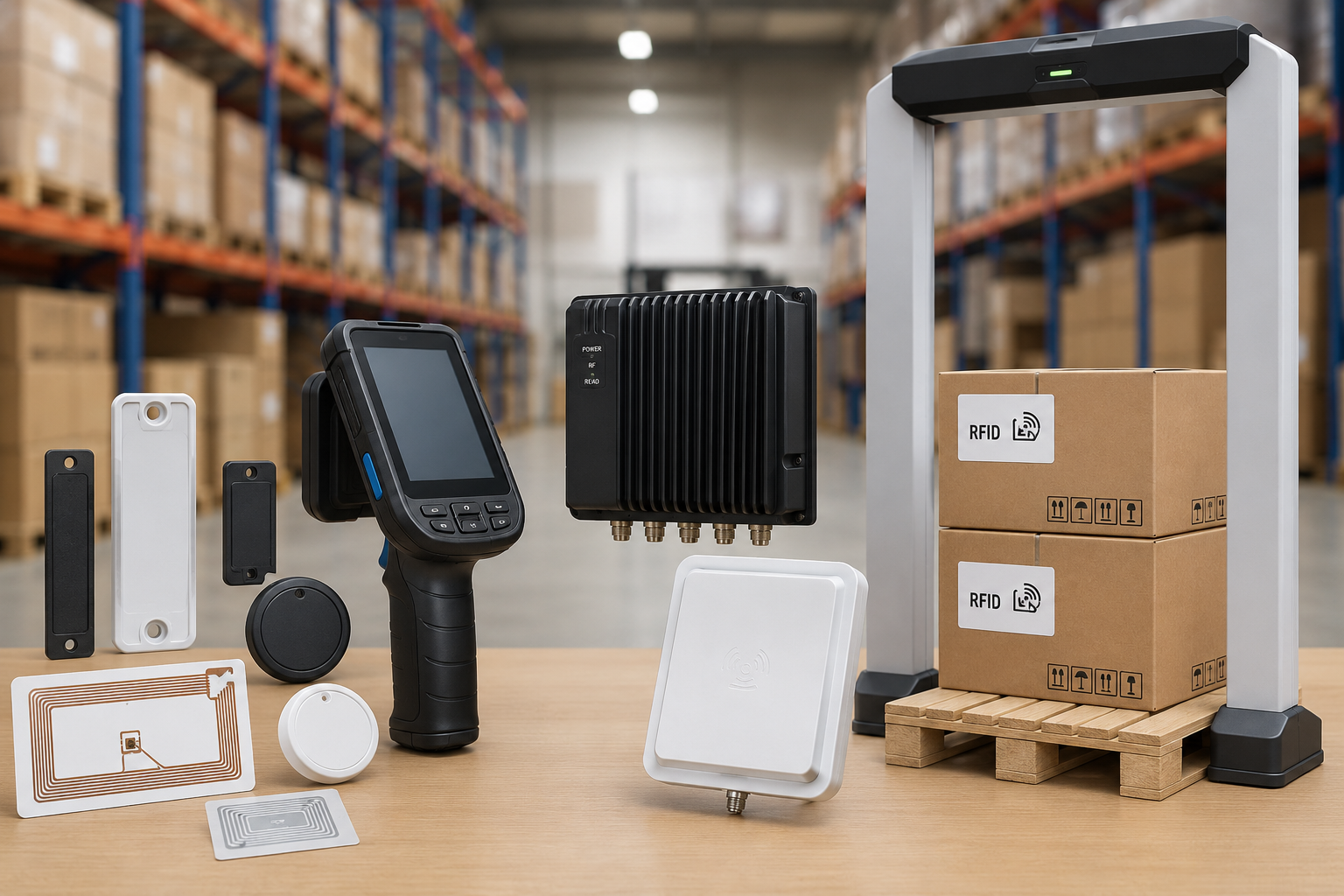
Quick answer: An RFID tag stores identification data, while an RFID reader uses radio signals to read that data wirelessly. The reader, antenna and software then transfer the information to a warehouse, inventory or business system.
What is an RFID tag?
An RFID tag is a small electronic device that stores information about an item, product, pallet, asset or container. The tag normally contains a chip and an antenna. When the tag receives a signal from an RFID reader, it responds with its stored information.
RFID tags are available in many formats, including labels, hard tags, cards, wristbands, asset tags and special tags for metal surfaces or demanding industrial environments.
Types of RFID tags
- Passive RFID tags: do not have a battery and are powered by the RFID reader signal.
- Active RFID tags: include a battery and can support longer read ranges.
- Semi-passive RFID tags: use a battery for internal functions but still communicate through the reader signal.
- On-metal RFID tags: are designed to work on metal surfaces where standard tags may perform poorly.
- RFID labels: combine printable label material with an RFID inlay for product and logistics labelling.
What is an RFID reader?
An RFID reader is the device that communicates with RFID tags. It sends radio frequency signals through an antenna and receives responses from tags within the reading area.
The reader sends the collected information to software, a warehouse management system, ERP platform or inventory system. This makes RFID useful for real-time tracking, automation and data capture.
Common RFID reader types
| Reader type | Best use |
| Fixed RFID reader | Dock doors, gates, conveyors and automated reading points |
| Handheld RFID reader | Inventory counting, asset tracking and mobile warehouse tasks |
| Vehicle-mounted RFID reader | Forklifts, warehouse vehicles and logistics movement tracking |
| Desktop RFID reader | Encoding, testing and workstation-based RFID processes |
RFID antennas
RFID antennas control how the reader sends and receives radio signals. The antenna choice affects read range, coverage area, direction and reliability.
Common options include linear antennas, circular antennas, indoor antennas, outdoor antennas and special antennas for portals, conveyors or compact reading zones.
How RFID tags and readers work together
- The RFID reader sends a radio signal through the antenna.
- An RFID tag enters the reading area and receives the signal.
- The tag responds with its stored identification data.
- The reader captures the response and sends it to software.
- The software processes the information and updates the connected system.
Choosing the right RFID tag
The correct RFID tag depends on the item, environment and required read performance. A tag used on cardboard packaging is different from a tag used on metal tools, returnable containers or outdoor assets.
- Required reading distance
- Material of the item, such as metal, plastic or cardboard
- Exposure to moisture, dust, chemicals or temperature changes
- Label size and available mounting surface
- Memory requirements and encoding needs
- Indoor, outdoor or industrial use
Choosing the right RFID reader
The reader should match the workflow. Fixed readers are suitable for automated points such as dock doors or conveyors, while handheld readers are better for mobile inventory counts and flexible asset tracking.
Important factors include read range, number of antennas, connection options, software compatibility, environment, mounting position and whether the reader will be used manually or automatically.
RFID tags, readers and barcode technology
RFID does not always replace barcode technology. Many companies use RFID together with barcodes. RFID is strong for automation and bulk reading, while barcodes remain cost-effective for printed labels and simple scanning tasks.
A complete identification solution may include barcode scanners, label printers, barcode labels, RFID tags, RFID readers and warehouse software.
FAQ – RFID tags and RFID readers
What is an RFID tag?
An RFID tag is a small electronic tag that stores identification data and communicates wirelessly with an RFID reader using radio frequency signals.
What is an RFID reader?
An RFID reader is a device that sends radio signals, reads RFID tags and transfers the collected data to software, inventory systems or warehouse management systems.
Can one RFID reader read many tags?
Yes. Depending on the RFID system, reader, antenna setup and environment, one RFID reader can often read multiple tags within the reading area.
Which RFID tag should I choose?
The right RFID tag depends on the application, material, environment, reading distance and durability requirements. For metal, outdoor or industrial use, specialised RFID tags may be required.
Need help choosing RFID tags or readers?
Contact Streckkods-Center for advice on RFID tags, RFID readers, antennas, barcode scanners, label printers and identification solutions for your business.
Email: info@streckkodscenter.se
Phone: +46 (0)31-27 42 30