- Unbeatable prices all year round
- Flat-rate shipping on many products.
- +46 (0)31-27 42 30
- info@streckkodscenter.se

RFID for Warehouses and Logistics
RFID for warehouses and logistics helps companies identify, track and manage goods faster using radio frequency technology, RFID tags, readers, antennas and warehouse software.
RFID can improve inventory accuracy, automate data collection, reduce manual scanning and create better visibility across warehouse, transport and supply chain operations.
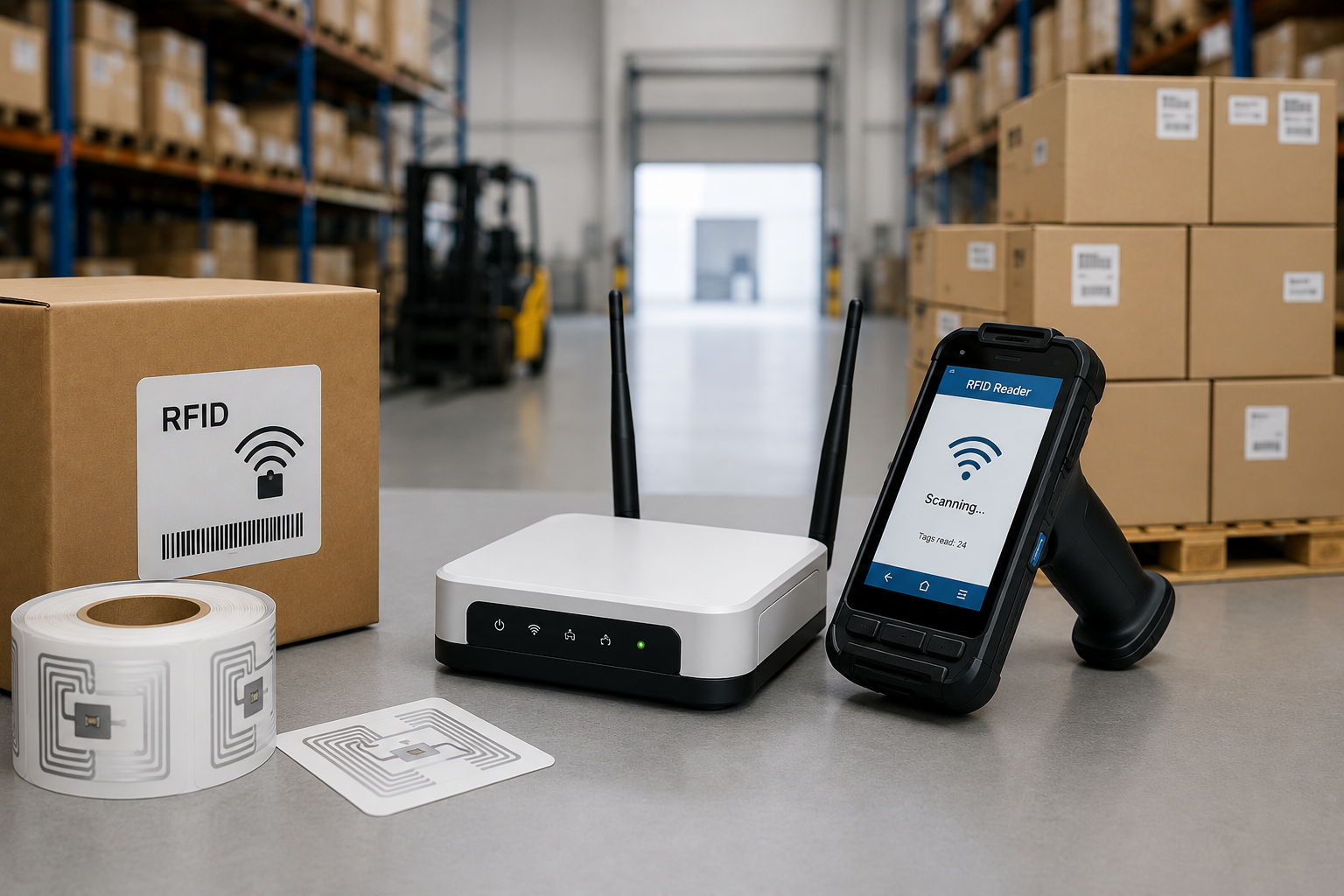
Quick answer: RFID improves warehouse and logistics operations by allowing items, pallets, containers and assets to be identified wirelessly. This makes inventory counting faster, improves traceability and supports automation without scanning every barcode manually.
What is RFID in warehouses?
RFID, or Radio Frequency Identification, is used in warehouses to track products, pallets, cartons, locations and returnable assets. An RFID tag is attached to an item or load carrier, and an RFID reader captures the tag information using radio waves.
Unlike standard barcode scanning, RFID does not always require direct line-of-sight. This means multiple tagged items can often be read faster, which is useful in busy warehouses and logistics environments.
How RFID improves warehouse operations
RFID can improve many daily warehouse processes by reducing manual scanning and increasing the speed of identification. It is especially useful when items move quickly, when pallets are handled in bulk or when a company needs better visibility of goods and assets.
- Goods receiving: identify incoming goods faster at the dock.
- Put-away: connect items and pallets to warehouse locations.
- Inventory counting: count tagged items faster than manual scanning.
- Picking and packing: verify goods and reduce handling errors.
- Shipping: confirm outgoing pallets, cartons and transport units.
- Asset tracking: follow tools, equipment and returnable containers.
RFID in logistics
In logistics, RFID can be used to track shipments, pallets, cages, bins, containers and other transport units. RFID readers can be installed at gates, dock doors, conveyor lines or loading zones to capture movement automatically.
This helps logistics companies improve shipment visibility, reduce manual checks and create better control over goods as they move between warehouses, vehicles, distribution centres and customers.
RFID vs barcode in warehouses
| Feature | RFID | Barcode |
| Reading method | Radio waves | Optical scanning |
| Line of sight | Not always required | Required |
| Bulk reading | Yes, depending on setup | Usually one item at a time |
| Cost | Higher tag and system cost | Lower label cost |
| Best use | Automation, tracking and fast inventory | Product labels, shipping labels and low-cost scanning |
Benefits of RFID for warehouse and logistics
- Faster inventory counting and stock checks
- Improved visibility of goods, pallets and assets
- Reduced manual scanning and paperwork
- Better traceability across warehouse and transport flows
- Support for automated receiving and shipping processes
- Improved control of returnable transport items
- More accurate data for WMS, ERP and logistics systems
RFID equipment used in warehouses
A warehouse RFID solution normally includes several connected components. The right setup depends on the items being tracked, the reading distance, the warehouse layout and the systems that need to receive the data.
- RFID tags: attached to products, pallets, cartons, tools or assets.
- RFID readers: capture tag data using radio frequency signals.
- RFID antennas: control the reading area and signal direction.
- Mobile RFID devices: allow workers to scan items on the warehouse floor.
- RFID software: filters, processes and connects data to WMS or ERP systems.
Common RFID warehouse applications
RFID can be used in many warehouse processes, from simple asset tracking to more advanced automated data capture. It is especially useful in environments where speed and visibility are important.
- Inventory management and cycle counting
- Pallet tracking and carton tracking
- Dock door and gate reading
- Returnable transport item tracking
- Tool and equipment tracking
- Production and work-in-progress tracking
- Shipment verification and dispatch control
Choosing the right RFID solution
Before choosing RFID, start by analysing the warehouse workflow. Identify which items need to be tracked, where reading should happen and how the information should be used. The tag type, reader placement and software integration are critical for reliable results.
RFID is often most valuable where manual scanning is slow, where many assets must be tracked, or where goods move through fixed points such as gates, conveyors or loading docks.
RFID and barcode technology together
RFID does not have to replace barcode technology. In many warehouse and logistics operations, RFID and barcodes work together. Barcodes are cost-effective for product and shipping labels, while RFID is useful for automation, bulk reading and asset tracking.
A complete warehouse solution may include barcode scanners, mobile computers, label printers, barcode labels, RFID readers, RFID tags and warehouse software.
FAQ – RFID for warehouses and logistics
Why use RFID in warehouses?
RFID helps warehouses identify goods, pallets and assets faster. It can improve inventory accuracy, reduce manual scanning and support more automated warehouse workflows.
Does RFID replace barcode scanning?
Not always. Many companies use RFID and barcodes together. Barcodes are cost-effective for product labels, while RFID is useful for automation, bulk reading and asset tracking.
Can RFID improve inventory accuracy?
Yes. RFID can improve inventory accuracy by making it faster and easier to identify tagged goods, pallets and assets during receiving, counting, movement and shipping.
Is RFID suitable for logistics?
Yes. RFID is useful in logistics for tracking shipments, pallets, returnable transport items, containers and movement through loading docks, gates and distribution centres.
Need help with RFID for warehouses or logistics?
Contact Streckkods-Center for advice on RFID, barcode scanners, mobile computers, label printers, labels and identification solutions for warehouse and logistics workflows.
Email: info@streckkodscenter.se
Phone: +46 (0)31-27 42 30