- Unbeatable prices all year round
- Flat-rate shipping on many products.
- +46 (0)31-27 42 30
- info@streckkodscenter.se

QR Code Guide for Businesses
QR codes have become one of the most widely used technologies for product information, digital payments, logistics, customer engagement and inventory management across modern businesses.
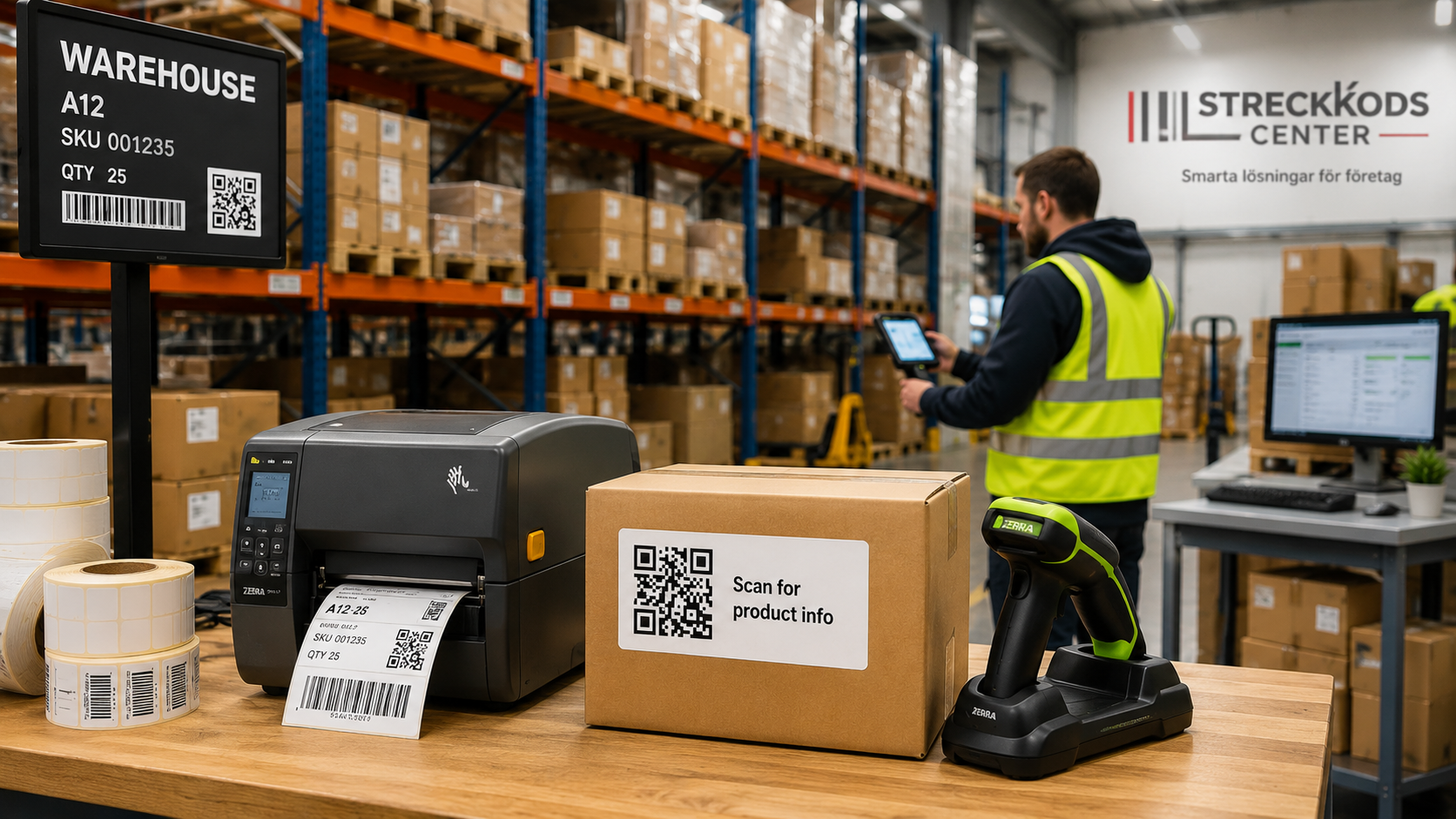
Unlike traditional 1D barcodes, QR codes can store significantly more information and can be scanned from both printed labels and digital screens. This flexibility has made QR technology highly valuable for retail, warehouses, healthcare, logistics and industrial operations.
Today, QR codes are used for everything from product traceability and inventory management to marketing campaigns and mobile customer experiences.
Business advantage: QR codes improve accessibility, simplify information sharing and support digital workflows without requiring complex hardware installations.
What is a QR code?
A QR code (Quick Response code) is a two-dimensional barcode capable of storing large amounts of information in a compact format. QR codes can contain URLs, serial numbers, contact information, product data and tracking information.
Because QR codes can be scanned quickly from multiple angles and surfaces, they are ideal for modern digital and industrial environments.
Benefits of QR codes for businesses
- Fast access to digital information
- Easy scanning from smartphones and tablets
- Supports product traceability and inventory systems
- Reduces manual data entry errors
- Improves customer engagement and marketing
- Compatible with modern barcode scanners and mobile devices
QR codes in retail and e-commerce
Retail businesses use QR codes for product information, self-service checkout, loyalty programs, digital coupons and payment systems. QR technology also improves customer experiences by linking physical products directly to online content.
In e-commerce logistics, QR codes are often used on shipping labels, warehouse locations and return management systems.
QR codes in warehouses and logistics
Warehouses and logistics centers use QR codes to simplify inventory handling, pallet tracking, shipment verification and internal process management.
Compared to traditional barcodes, QR codes can store more detailed operational information while remaining compact and easy to scan.
QR codes vs traditional barcodes
| Feature | Traditional Barcode | QR Code |
|---|---|---|
| Data capacity | Limited | High |
| Scanning direction | Linear | 360° |
| Mobile phone scanning | Limited | Excellent |
| Digital integration | Basic | Advanced |
| Information storage | Low | Very high |
Choosing the right QR code scanner
Businesses using QR technology should invest in reliable 2D barcode scanners capable of handling both printed and digital QR codes efficiently.
Modern barcode scanners support QR codes, Data Matrix and traditional barcode formats within the same device.
The future of QR technology
QR codes continue to grow rapidly in importance as businesses increase digitalization, automation and mobile interaction.
Future QR applications are expected to expand further within smart manufacturing, healthcare, warehouse automation and connected supply chain systems.
FAQ – QR codes for businesses
Yes. Most modern smartphones can scan QR codes directly using the built-in camera application.
QR codes provide higher data capacity and better digital integration, but traditional barcodes are still widely used in retail and logistics.
No. QR codes themselves do not require internet access, but linked online content naturally does.
Need help choosing QR code solutions?
Contact Streckkods-Center for professional advice regarding QR codes, barcode scanners and warehouse identification systems.
Email: info@streckkodscenter.se
Phone: +46 (0)31-27 42 30