- Unbeatable prices all year round
- Flat-rate shipping on many products.
- +46 (0)31-27 42 30
- info@streckkodscenter.se

Industrial Barcode Scanners
Industrial barcode scanners are designed for demanding environments where reliable scanning, rugged construction and fast data capture are essential for warehouse, logistics and manufacturing operations.
This guide explains how rugged barcode scanners improve productivity, reduce errors and support modern industrial workflows in warehouses, production lines and distribution centres.
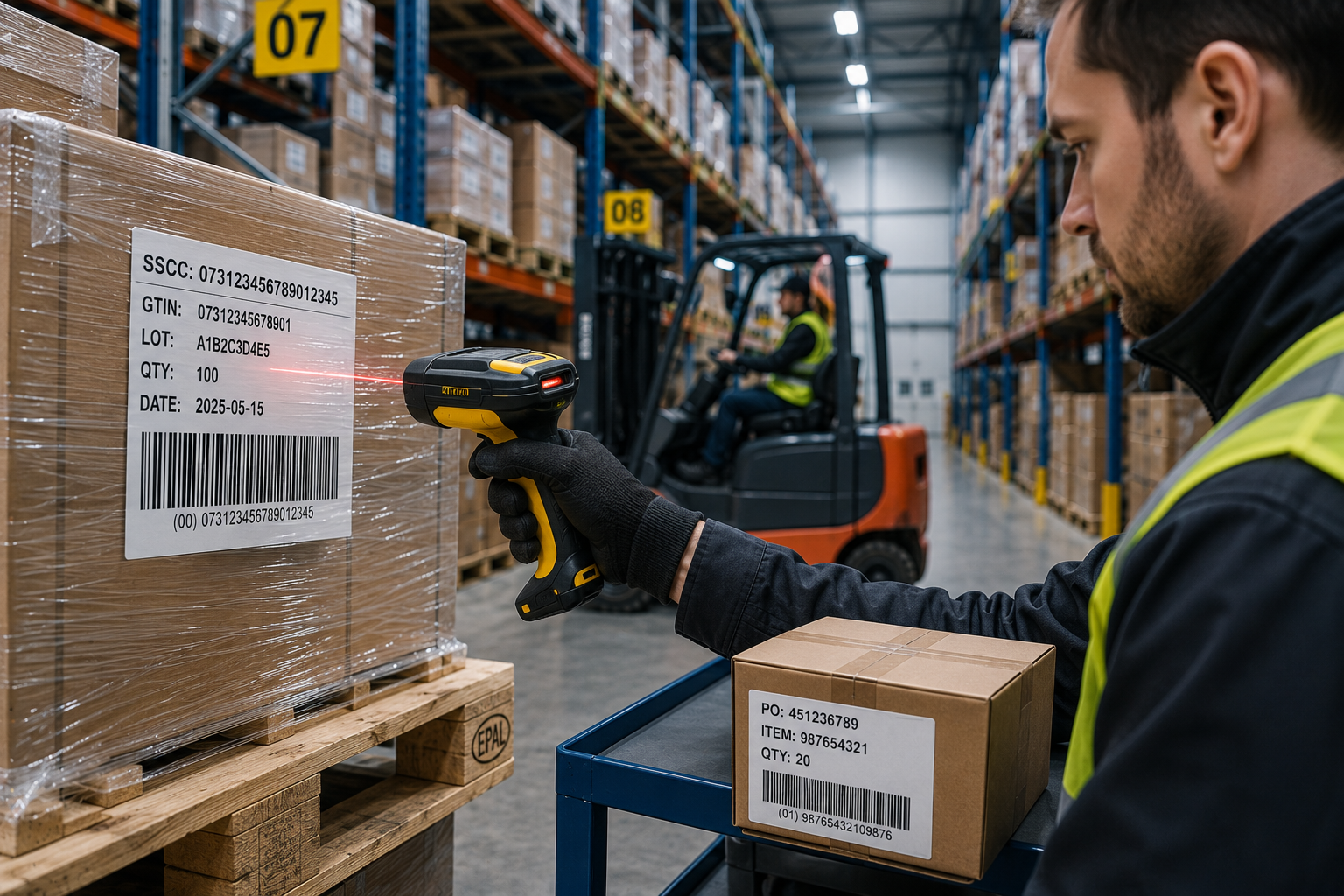
Quick answer: Industrial barcode scanners are rugged barcode readers built for tough environments. They are used for warehouse picking, receiving, shipping, manufacturing, inventory control and asset tracking where speed and reliability matter.
What is an industrial barcode scanner?
An industrial barcode scanner is a barcode reader designed to withstand demanding daily use in warehouses, factories, logistics centres and production environments. Compared with standard retail scanners, industrial models are usually more durable and better suited for dust, vibration, temperature changes and repeated drops.
Industrial scanners can read 1D and 2D barcodes from product labels, pallet labels, shipping labels, work orders, racks, bins and packaging. Many models support wireless operation, long-range scanning and advanced decoding for damaged or poorly printed barcodes.
Where industrial barcode scanners are used
- Warehouses and distribution centres
- Manufacturing and production lines
- Logistics and transport operations
- Goods receiving and shipping areas
- Cold storage and demanding environments
- Forklift and vehicle-based workflows
- Inventory counting and asset tracking
Key features of industrial barcode scanners
| Feature | Why it matters |
| Rugged housing | Protects the scanner from drops, shocks and daily industrial use. |
| 1D and 2D scanning | Supports common barcode types including Code 128, GS1-128, EAN, QR codes and Data Matrix. |
| Long-range scanning | Allows operators to scan pallet labels, rack labels and high storage locations from a distance. |
| Wireless connectivity | Gives mobile workers more freedom in warehouses and logistics areas. |
| Advanced decoding | Improves reading of damaged, dirty or poorly printed barcodes. |
Benefits of industrial barcode scanners
- Faster workflows: speed up picking, receiving, shipping and inventory tasks.
- Improved accuracy: reduce manual entry errors and incorrect product handling.
- Higher productivity: support efficient scanning in demanding work areas.
- Better traceability: capture product, batch, pallet and shipment data reliably.
- Lower operating costs: reduce errors, rework and downtime.
- Reliable performance: designed for long-term use in industrial environments.
Types of industrial barcode scanners
Handheld industrial scanners
Handheld scanners are flexible and easy to use for goods receiving, picking, packing, inventory checks and general warehouse work. They are available in both corded and cordless versions.
Wireless industrial scanners
Wireless scanners are suitable for large facilities where operators need mobility. They are commonly used with forklifts, mobile workstations and warehouse management systems.
Fixed-mount industrial scanners
Fixed-mount scanners are installed in conveyor systems, production lines and automated processes. They read barcodes automatically as products, boxes or pallets pass a scanning point.
Choosing the right industrial scanner
The right scanner depends on the environment, barcode type, scanning distance and workflow. A scanner used at a packing station may have different requirements than a scanner used on a forklift or in a cold storage area.
- Scanning distance and barcode size
- 1D, 2D or direct part mark requirements
- Barcode quality and label condition
- IP rating and drop resistance
- Bluetooth, USB, serial or network connectivity
- Battery life for wireless models
- Ergonomics and daily user comfort
- Compatibility with WMS, ERP and inventory systems
Industrial scanners in warehouse automation
Industrial barcode scanners are an important part of warehouse automation. They help connect physical goods with digital systems by capturing accurate data from products, bins, pallets and shipments.
Combined with label printers, mobile computers, RFID, WMS software and inventory systems, industrial scanners support faster and more reliable operations from receiving to dispatch.
Popular applications
- Warehouse picking
- Inventory counting
- Goods receiving
- Shipping and dispatch
- Production tracking
- Quality control
- Asset tracking
- Pallet and carton identification
FAQ – Industrial barcode scanners
What is an industrial barcode scanner?
An industrial barcode scanner is a rugged barcode reader designed for demanding environments such as warehouses, manufacturing, logistics and distribution centres.
Can industrial scanners read damaged barcodes?
Many industrial scanners are designed with advanced decoding technology that can read damaged, dirty or poorly printed barcodes more reliably than standard scanners.
Are industrial barcode scanners waterproof?
Some industrial scanners have IP-rated protection against dust and water. The required IP rating depends on the environment where the scanner will be used.
What industries use industrial barcode scanners?
Industrial barcode scanners are used in warehousing, logistics, manufacturing, retail distribution, healthcare, transport, cold storage and asset management.
Need help choosing an industrial barcode scanner?
Contact Streckkods-Center for advice on rugged barcode scanners, warehouse automation, label printers, mobile computers and industrial data capture solutions.
Email: info@streckkodscenter.se
Phone: +46 (0)31-27 42 30