- Unbeatable prices all year round
- Flat-rate shipping on many products.
- +46 (0)31-27 42 30
- info@streckkodscenter.se

How ESL Improves Price Accuracy
Electronic Shelf Labels (ESL) help retailers improve price accuracy by keeping shelf prices synchronized with central pricing systems, POS data and ERP information.
By replacing manual paper label updates with digital price labels, stores can reduce pricing errors, improve customer trust and make campaign management more reliable.
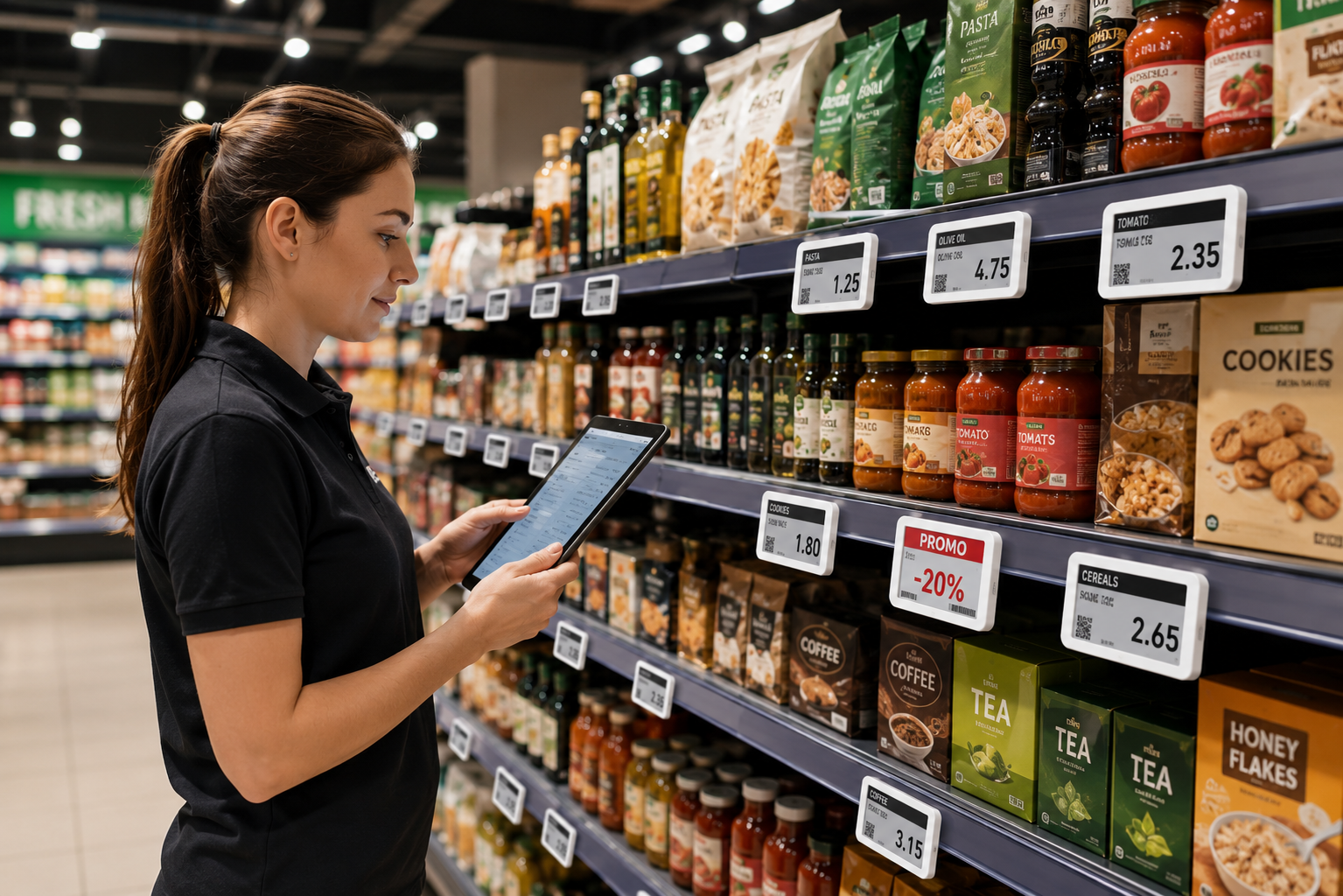
Quick answer: ESL improves price accuracy by automatically updating shelf labels from one central system. This reduces manual mistakes, keeps prices aligned with checkout systems and helps customers see the correct price directly at the shelf.
Why price accuracy matters in retail
Price accuracy is essential for customer trust. When the price on the shelf does not match the price at checkout, it creates frustration, extra work for staff and a less professional customer experience.
Accurate pricing also affects profitability, campaign performance and store operations. Retailers with many products, frequent campaigns or multiple store locations need reliable systems to keep prices consistent.
Common causes of pricing errors
- Manual label changes: paper labels must be printed, sorted and replaced by staff.
- Delayed updates: shelf prices may not be changed at the same time as POS prices.
- Human errors: labels can be placed on the wrong shelf or product.
- Frequent campaigns: promotions increase the number of price changes.
- Large assortments: more products create more opportunities for errors.
- Multiple systems: disconnected pricing, inventory and checkout systems increase risk.
How ESL improves price accuracy
Electronic Shelf Labels reduce pricing errors by replacing manual shelf label changes with automatic digital updates. Prices can be managed centrally and sent directly to the labels in the store.
When ESL is integrated with POS, ERP or pricing systems, the same product data can be used both at checkout and on the shelf. This helps ensure that customers see the correct price before they reach the register.
ESL price accuracy process
| Step | How ESL helps |
| Central price update | Price changes are managed in one system instead of manually at each shelf. |
| POS synchronization | Shelf prices can match checkout prices more reliably. |
| Campaign control | Promotions can start and stop at the correct time. |
| Reduced manual handling | Fewer printed labels means fewer placement and replacement errors. |
| Store-wide consistency | Prices can be updated across departments or locations more consistently. |
POS and ERP integration
One of the strongest advantages of ESL is integration with central business systems. When the ESL platform receives data from POS, ERP, inventory or pricing software, the risk of duplicated work and inconsistent data is reduced.
This is especially valuable for retail chains, supermarkets, pharmacies and stores with frequent campaign pricing or large product ranges.
Benefits of accurate shelf pricing
- Higher customer trust
- Fewer price complaints at checkout
- Reduced manual correction work for staff
- More reliable campaign execution
- Better price consistency across the store
- Improved store efficiency
- Better support for digital pricing and retail automation
Industries that benefit most
ESL is especially useful in retail environments where prices change often or where accuracy is critical. The more products and promotions a store has, the greater the value of automated price updates.
- Supermarkets and grocery stores
- Pharmacies and health stores
- Electronics retailers
- DIY and hardware stores
- Convenience stores
- Retail chains with multiple locations
ESL compared with paper price labels
Paper price labels can work well in small stores with few price changes. However, when price updates become frequent, the risk of incorrect labels increases. ESL provides a more controlled and scalable way to manage pricing.
For retailers focused on price accuracy, ESL can reduce errors, save staff time and support a more professional customer experience.
FAQ – ESL and price accuracy
How does ESL improve price accuracy?
ESL improves price accuracy by updating shelf labels automatically from a central system, reducing manual label errors and keeping shelf prices aligned with POS and ERP data.
Can ESL eliminate pricing errors?
ESL can greatly reduce pricing errors, but correct system setup, product data and integration are still important for the best result.
Does ESL integrate with POS systems?
Yes. Modern ESL systems can integrate with POS, ERP, pricing and inventory systems so shelf prices stay synchronized with central business data.
Why is price accuracy important in retail?
Price accuracy helps build customer trust, reduces complaints, improves checkout flow and supports a more efficient and reliable store operation.
Need help improving price accuracy with ESL?
Contact Streckkods-Center for advice on Electronic Shelf Labels, digital price labels, POS integration, barcode scanners and retail automation solutions.
Email: info@streckkodscenter.se
Phone: +46 (0)31-27 42 30