- Unbeatable prices all year round
- Flat-rate shipping on many products.
- +46 (0)31-27 42 30
- info@streckkodscenter.se
GS1 and EAN Barcode Guide
GS1 and EAN barcodes are global standards used for product identification, retail operations, logistics and supply chain management across industries worldwide.
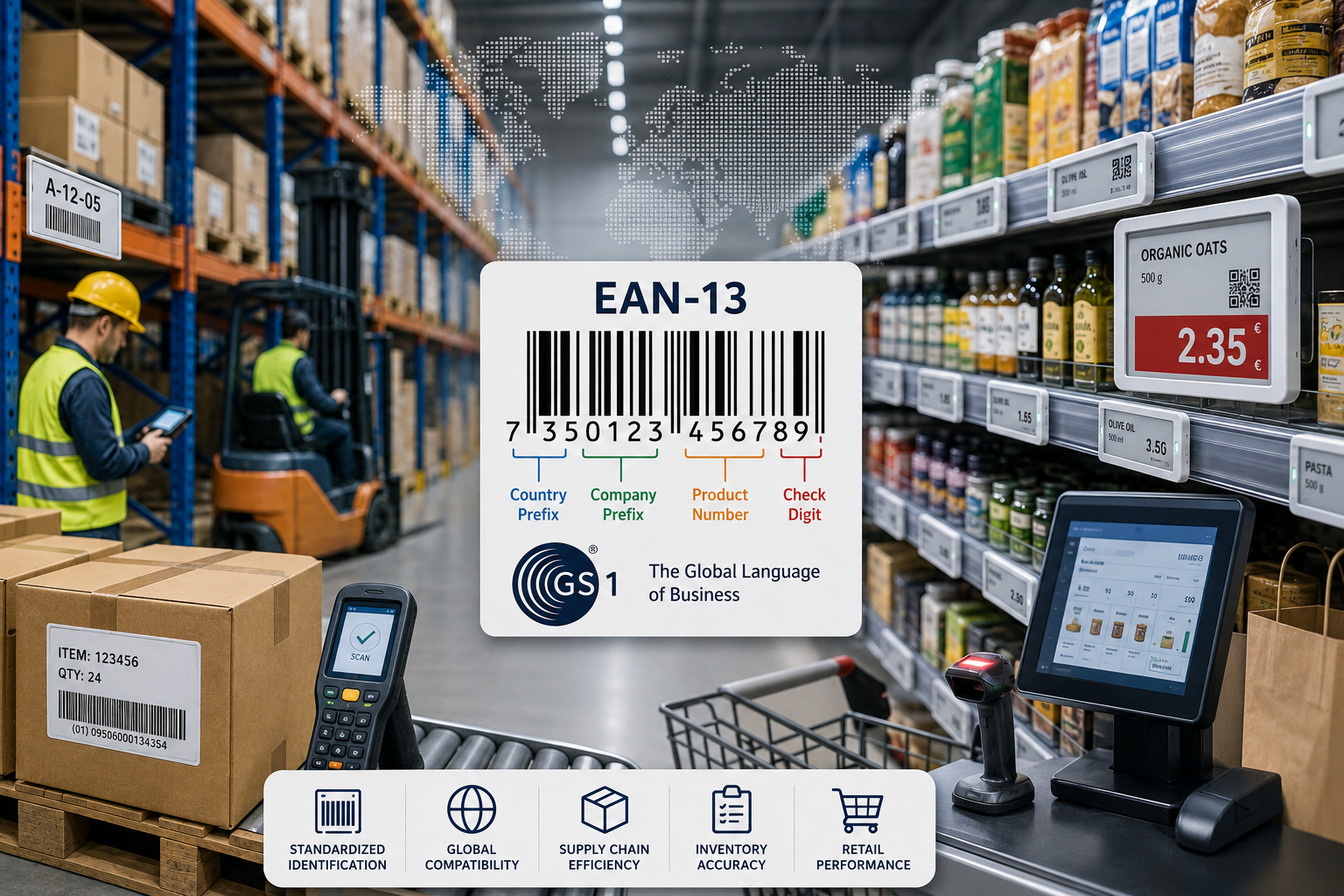
Businesses selling products online, in retail stores or through distributors often require standardized barcodes to ensure compatibility with POS systems, warehouses and international supply chains.
GS1 standards provide a globally recognized structure for product identification, while EAN barcodes are among the most commonly used barcode formats for retail packaging and consumer products.
Important: Using official GS1 barcode standards improves compatibility with retailers, logistics providers, e-commerce platforms and inventory systems.
What is GS1?
GS1 is an international standards organization responsible for global barcode systems and supply chain identification standards. GS1 standards are used in retail, healthcare, logistics, manufacturing and e-commerce worldwide.
Companies using GS1 receive unique company prefixes that allow products to be identified globally through standardized barcode systems.
What is an EAN barcode?
EAN, European Article Number, is one of the most widely used barcode formats for retail products. EAN barcodes are commonly printed on packaging and scanned at checkout systems worldwide.
The most common format is EAN-13, which contains thirteen digits identifying the country code, company prefix and product reference number.
Benefits of GS1 and EAN standards
- Global product identification
- Compatible with retail POS systems
- Improves supply chain traceability
- Supports inventory management systems
- Accepted by major retailers and marketplaces
- Reduces product handling errors
- Supports international business operations
EAN-13 barcode structure
An EAN-13 barcode consists of thirteen numerical digits divided into different identification sections.
| Section | Purpose |
|---|---|
| Country prefix | Identifies GS1 member organization |
| Company prefix | Identifies manufacturer or brand owner |
| Product number | Unique product reference |
| Check digit | Ensures barcode accuracy during scanning |
Where are GS1 barcodes used?
GS1 barcode standards are used across multiple industries including retail, grocery, healthcare, manufacturing, transportation and e-commerce.
Retailers and logistics providers rely on GS1-compatible barcodes for efficient checkout operations, inventory management and shipment tracking.
Choosing barcode printers and scanners
Businesses working with GS1 and EAN standards require reliable label printers and barcode scanners to ensure accurate barcode printing and scanning quality.
High-quality barcode printing is essential for maintaining readability throughout the supply chain.
GS1 and digital transformation
As digital supply chains expand, GS1 standards continue evolving to support QR codes, product traceability, sustainability initiatives and connected product information systems.
Future barcode systems are expected to combine traditional EAN structures with advanced digital identification technologies.
FAQ – GS1 and EAN barcodes
GS1 is the global organization responsible for barcode and supply chain identification standards.
GS1 manages the global standard system, while EAN is one of the barcode formats used within that system.
Many major marketplaces and retailers prefer or require official GS1 barcode registrations for product listings.
Need help with barcode solutions?
Contact Streckkods-Center for professional advice regarding GS1 barcodes, EAN labels, barcode scanners and printing solutions.
Email: info@streckkodscenter.se
Phone: +46 (0)31-27 42 30