- Unbeatable prices all year round
- Flat-rate shipping on many products.
- +46 (0)31-27 42 30
- info@streckkodscenter.se

ESL vs. Paper Shelf Labels
Electronic Shelf Labels (ESL) and traditional paper shelf labels both help retailers show prices and product information, but they differ greatly in speed, accuracy, labour requirements and long-term efficiency.
This guide compares ESL and paper shelf labels to help retailers understand when digital price labels are the better choice and when paper labels may still be suitable.
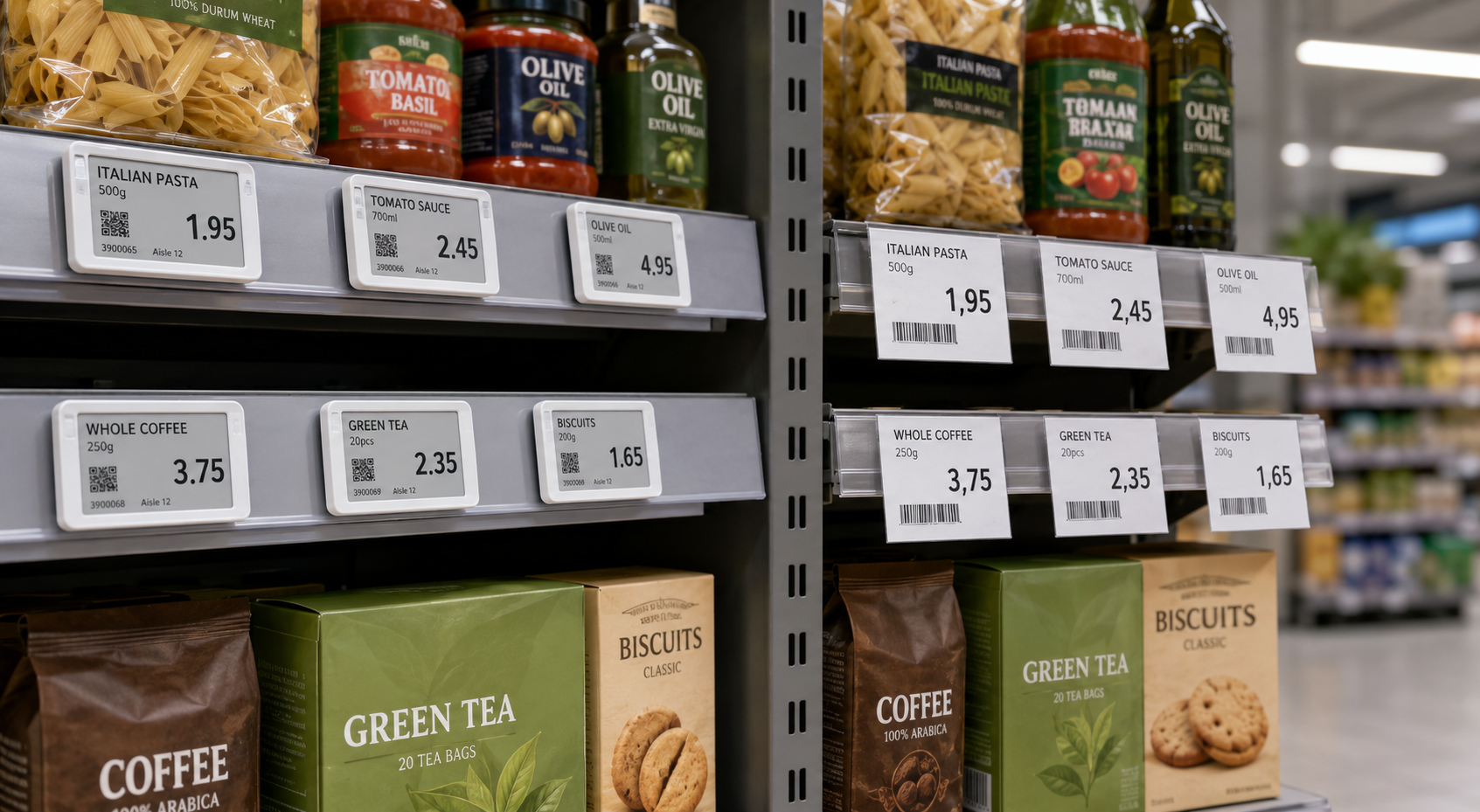
Quick answer: ESL labels are best for retailers that need fast price updates, high pricing accuracy, reduced manual work and centralised price control. Paper shelf labels are cheaper to start with but require more manual labour and are harder to keep updated.
What are paper shelf labels?
Paper shelf labels are printed labels placed on shelf edges to show product prices, names, barcodes, campaign information and other details. They are common in supermarkets, pharmacies, DIY stores, retail shops and warehouses.
Paper labels are simple, inexpensive and easy to understand. However, every price change requires printing, sorting, replacing and checking labels manually, which can become time-consuming in stores with many products or frequent campaigns.
What are Electronic Shelf Labels?
Electronic Shelf Labels, often called ESL, are digital price labels used on retail shelves. Instead of printing new paper labels, prices and product information are updated wirelessly from central software.
ESL systems can display prices, promotions, product names, barcodes, QR codes, stock information and other retail data. They are commonly used in grocery stores, electronics stores, pharmacies, convenience stores and modern retail environments.
ESL vs. paper shelf labels comparison
| Feature | Electronic Shelf Labels | Paper Shelf Labels |
| Price updates | Automatic and centralised | Manual replacement |
| Pricing accuracy | Very high when integrated with POS/ERP | Depends on manual work |
| Labour requirement | Low after installation | High during price changes |
| Campaigns | Can be updated quickly | Requires printing and replacement |
| Sustainability | Less paper waste | Continuous paper usage |
| Initial cost | Higher | Lower |
| Best for | Retailers with many price updates | Small stores with few changes |
Benefits of Electronic Shelf Labels
- Faster price changes: update prices centrally without manually replacing labels.
- Better pricing accuracy: reduce the risk of shelf prices not matching the POS system.
- Lower labour costs: staff spend less time printing and changing labels.
- Real-time promotions: campaigns can be scheduled and updated quickly.
- Improved customer experience: clear and consistent shelf information builds trust.
- Reduced paper waste: fewer printed labels are needed over time.
- Retail automation: ESL supports digital pricing, inventory visibility and store efficiency.
Benefits of paper shelf labels
Paper shelf labels still have advantages in certain situations. They are inexpensive to start with, simple to print and do not require wireless infrastructure or software integration.
- Low initial investment
- Easy to understand and implement
- No batteries or wireless system required
- Suitable for small stores with few products
- Useful for temporary displays or simple shelf marking
When should you choose ESL?
ESL is usually the better choice when a store has many products, frequent price changes, campaign pricing, multiple departments or a need to keep shelf prices synchronised with POS and ERP systems.
Electronic Shelf Labels are especially useful in supermarkets, pharmacies, electronics stores, DIY stores, convenience stores and retail chains where pricing accuracy and operational efficiency are important.
When are paper labels still suitable?
Paper labels can still be suitable for small stores, low-change environments, temporary campaigns or businesses with a limited product range. They are also useful where digital systems are not yet connected or where the investment in ESL is not justified.
However, as product ranges grow and price changes become more frequent, the manual work involved with paper labels can quickly become expensive and error-prone.
Cost and return on investment
Paper shelf labels have a lower purchase cost, but they create ongoing costs through printing, paper usage, staff time and manual checking. ESL systems require a higher initial investment but can reduce labour and improve pricing accuracy over time.
For retailers with frequent price updates, dynamic pricing or large product assortments, ESL can provide a strong return on investment by reducing repetitive manual work and improving store efficiency.
ESL and store automation
Electronic Shelf Labels are not only digital price tags. They can become part of a wider retail automation strategy, connecting shelf prices with POS systems, ERP platforms, inventory data and campaign management.
A complete retail technology setup may include ESL, barcode scanners, mobile computers, label printers, POS systems and inventory software for better control of prices, stock and store operations.
FAQ – ESL vs. paper shelf labels
Are Electronic Shelf Labels better than paper labels?
Electronic Shelf Labels are better for retailers with frequent price updates, large product ranges and a need for high pricing accuracy. Paper labels are cheaper for small stores with few changes.
How much time can ESL save?
ESL can save significant staff time because prices can be updated centrally instead of printing and replacing shelf labels manually throughout the store.
Are ESL labels expensive?
ESL labels have a higher initial cost than paper labels, but they can reduce labour, improve pricing accuracy and lower paper usage over time.
Can ESL integrate with POS and ERP systems?
Yes. Modern ESL systems can integrate with POS, ERP, inventory and pricing systems to keep shelf prices synchronized with central business data.
Need help choosing ESL or paper shelf labels?
Contact Streckkods-Center for advice on Electronic Shelf Labels, barcode scanners, label printers, labels and retail automation solutions for your business.
Email: info@streckkodscenter.se
Phone: +46 (0)31-27 42 30