- Unbeatable prices all year round
- Flat-rate shipping on many products.
- +46 (0)31-27 42 30
- info@streckkodscenter.se

ESL Integration with POS Systems
ESL integration with POS systems allows retailers to keep shelf prices synchronized with checkout prices, reducing manual work and improving pricing accuracy across the store.
When Electronic Shelf Labels are connected to POS, ERP and pricing systems, price updates can be managed centrally and sent automatically to digital shelf labels.
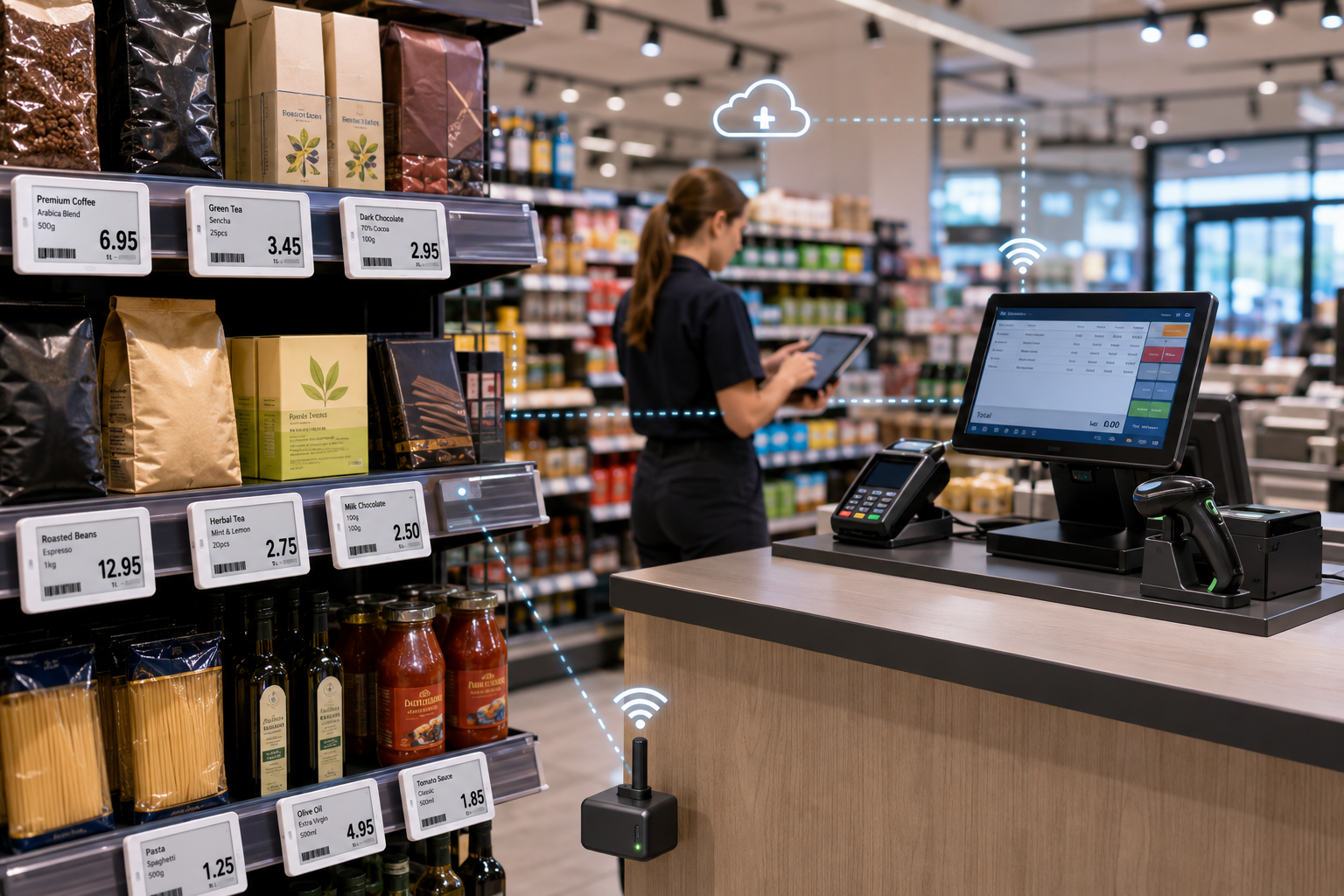
Quick answer: ESL POS integration connects Electronic Shelf Labels with the store’s point-of-sale system so that shelf prices, promotions and product information can be updated automatically from one central data source.
What is ESL POS integration?
ESL POS integration means connecting Electronic Shelf Labels with the store’s point-of-sale system. The goal is to make sure that the price shown on the shelf matches the price used at checkout.
Instead of updating paper labels manually, the store can send updated prices from POS, ERP or pricing software to the ESL platform. The ESL system then updates the correct digital shelf labels wirelessly.
Why POS integration matters
Price mismatches between shelf labels and checkout systems can create customer complaints, extra work for staff and reduced trust in the store. POS integration helps reduce this risk by using one central source for price data.
- Reduces manual price changes
- Improves pricing accuracy
- Keeps shelf and checkout prices synchronized
- Supports faster campaign updates
- Improves customer confidence
- Reduces repetitive work for store staff
How ESL connects to POS systems
A typical ESL integration connects the POS or pricing system with ESL management software. The ESL software receives product and price information, processes the update and sends it wirelessly to the correct shelf label.
| Component | Function |
| POS system | Stores checkout prices and product data |
| ERP or pricing system | Manages central pricing, campaigns and product information |
| ESL management software | Controls label content and sends updates |
| Base stations | Transmit updates wirelessly to shelf labels |
| Electronic Shelf Labels | Display updated prices and product information |
Typical ESL POS integration process
- A price is updated in the POS, ERP or pricing system.
- The updated data is sent to the ESL management platform.
- The ESL system matches the price to the correct shelf label.
- Base stations transmit the update wirelessly.
- The Electronic Shelf Label refreshes automatically.
- The shelf price and checkout price remain synchronized.
Benefits of ESL integration with POS
- Real-time price updates: update shelf labels quickly after price changes.
- Higher pricing accuracy: reduce errors between shelf and checkout prices.
- Reduced labour: less manual printing and label replacement.
- Faster promotions: campaigns can start and stop more efficiently.
- Central control: manage prices across one store or multiple locations.
- Better customer experience: accurate shelf prices increase customer trust.
Retail environments that benefit
ESL POS integration is valuable in retail environments where prices change often or where pricing accuracy is critical. The more products and campaigns a store manages, the more important automation becomes.
- Supermarkets and grocery stores
- Pharmacies and health stores
- Electronics retailers
- DIY and hardware stores
- Convenience stores
- Fashion and lifestyle retail
- Retail chains with multiple locations
Choosing an ESL solution for POS integration
When selecting an ESL system, retailers should check compatibility with existing POS, ERP and pricing systems. Integration options, API support, wireless coverage and central management are important for a stable solution.
- POS compatibility
- ERP and inventory system integration
- API or data exchange support
- Central price management
- Wireless coverage and base station planning
- Label size and display options
- Scalability for future store expansion
Security and data reliability
Reliable data exchange is important when POS prices are connected to shelf labels. The ESL system should use secure communication, correct product mapping and clear status monitoring so that failed updates can be detected quickly.
Good system design helps ensure that price updates are accurate, traceable and controlled across departments and store locations.
FAQ – ESL integration with POS systems
What is ESL POS integration?
ESL POS integration connects Electronic Shelf Labels with the store’s checkout or pricing system so shelf prices can update automatically from central data.
Can prices update automatically?
Yes. With the right integration, price changes can be sent automatically from POS, ERP or pricing software to the ESL platform and then to the shelf labels.
Does ESL work with existing POS systems?
Many ESL systems can integrate with existing POS systems, depending on data formats, API support and the integration options available from the POS provider.
Is POS integration secure?
A well-designed ESL integration uses controlled data exchange, secure communication and monitoring to help ensure accurate and reliable price updates.
Need help integrating ESL with your POS system?
Contact Streckkods-Center for advice on Electronic Shelf Labels, POS integration, digital pricing, barcode scanners and retail automation solutions.
Email: info@streckkodscenter.se
Phone: +46 (0)31-27 42 30