- Unbeatable prices all year round
- Flat-rate shipping on many products.
- +46 (0)31-27 42 30
- info@streckkodscenter.se

ESL for Warehouses and Retail
Electronic Shelf Labels (ESL) are used in both retail and warehouse environments to improve pricing, location marking, inventory workflows and digital information management.
Modern ESL systems help businesses update information wirelessly, reduce manual work, improve accuracy and connect shelf or storage locations with central business systems.
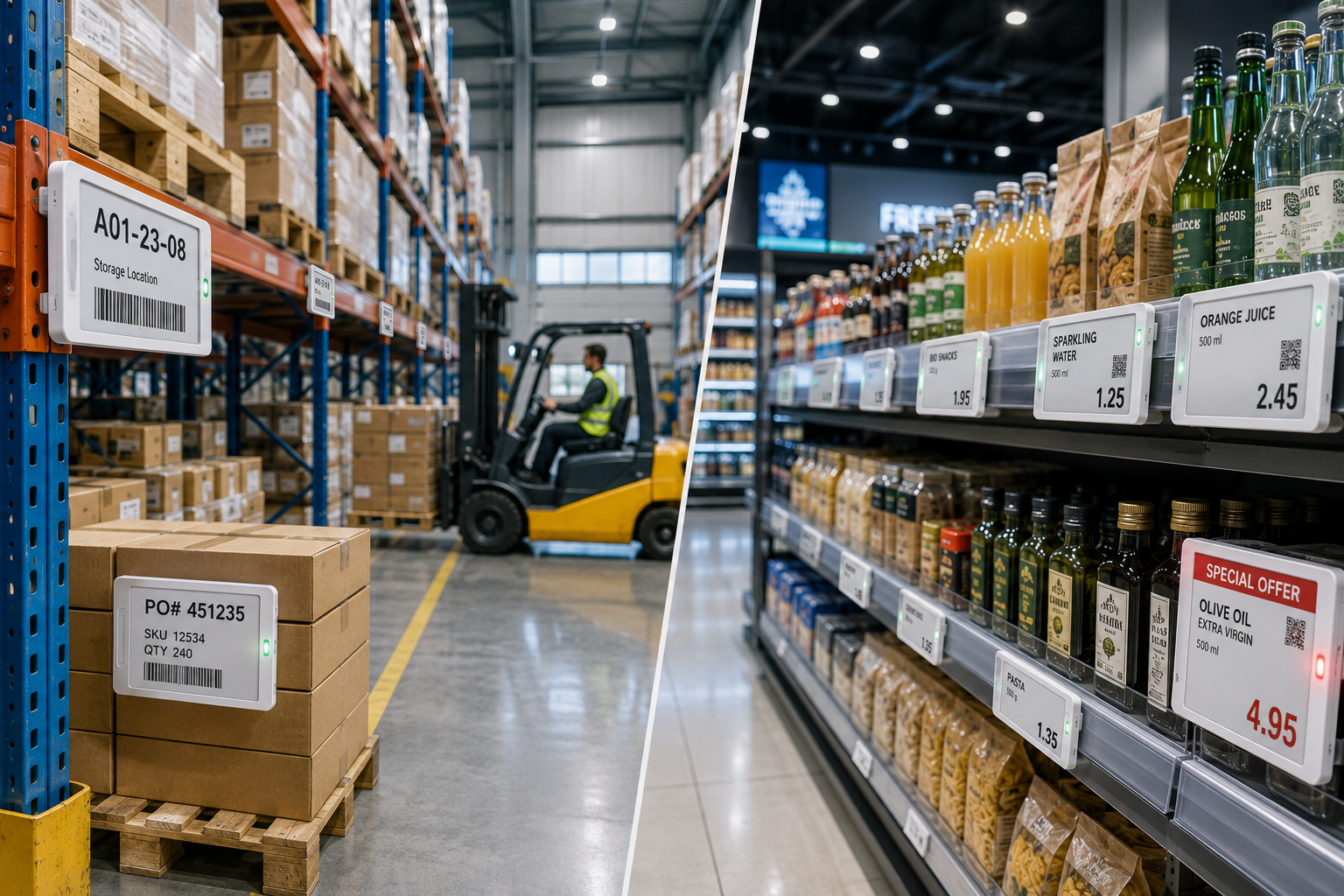
Quick answer: ESL labels are not only for retail pricing. They can also be used in warehouses for location identification, picking guidance, inventory control and digital workflow support.
What are ESL labels?
ESL stands for Electronic Shelf Labels. These are digital labels that can show prices, product information, location data, stock information, barcodes, QR codes or operational instructions.
Most ESL labels use e-paper displays and wireless communication. This makes them easy to read, energy efficient and suitable for stores, warehouses and logistics environments where information changes over time.
ESL in retail environments
In retail, ESL labels are mainly used as digital price labels. They replace traditional paper shelf labels and allow stores to update prices and product information from a central system.
- Automatic price updates
- Improved pricing accuracy
- Faster campaign management
- Reduced manual label replacement
- Clear customer information at the shelf
- Support for QR codes, barcodes and promotions
ESL in warehouse environments
In warehouses, ESL labels can be used for more than pricing. They can act as digital location labels, picking indicators, storage markers and inventory information displays.
Warehouse ESL labels can help staff identify locations, products, picking zones or storage areas faster. When connected to warehouse systems, they can support more flexible and accurate workflows.
Benefits across warehouses and retail
- Faster updates: change information centrally without printing new labels.
- Better accuracy: reduce manual mistakes and outdated shelf or location data.
- Lower labour: staff spend less time replacing labels manually.
- Flexible workflows: update prices, locations or instructions as operations change.
- Digital transformation: connect physical shelves and storage locations to central systems.
- Improved productivity: support faster picking, replenishment and store operations.
Warehouse ESL applications
| Application | How ESL helps |
| Location labels | Shows storage location, zone or shelf information digitally. |
| Picking guidance | Can support staff in finding the correct shelf or item faster. |
| Inventory control | Displays stock-related information or product identifiers. |
| Cross docking | Supports changing information in fast-moving logistics areas. |
| Packing stations | Can display instructions, order references or process information. |
Retail ESL applications
Retailers use ESL labels to keep shelf information accurate and up to date. This is especially valuable in stores with many products, frequent campaigns or several departments.
- Supermarkets and grocery stores
- Electronics retailers
- Pharmacies
- DIY and hardware stores
- Fashion and lifestyle stores
- Convenience stores
- Retail chains with multiple locations
Integrating ESL with business systems
ESL systems can become more powerful when integrated with other business systems. In retail, integration with POS and ERP systems helps keep prices synchronized. In warehouses, integration with WMS and inventory systems can support digital workflows.
- POS: synchronizes shelf prices with checkout prices.
- ERP: connects product, pricing and business data.
- WMS: supports warehouse locations, stock and picking information.
- Barcode scanners: help identify products and update workflows.
- Mobile computers: support staff interaction with warehouse and retail systems.
- RFID: can complement ESL in asset tracking and inventory control.
ESL vs traditional labels
Traditional printed labels are simple and inexpensive, but they require manual replacement whenever information changes. ESL labels are more flexible because they can be updated digitally.
For businesses with changing prices, storage locations, campaigns or inventory workflows, ESL can reduce manual work and improve information accuracy over time.
Choosing ESL for warehouses and retail
The right ESL solution depends on the environment. Retail stores may focus on price accuracy and customer-facing information, while warehouses may need durable labels, location support and integration with WMS systems.
- Display size and readability
- Wireless coverage
- Battery life
- Mounting options for shelves, racks or bins
- POS, ERP or WMS integration
- Software and central management
- Scalability across locations
- Future expansion and support
FAQ – ESL for warehouses and retail
Can ESL be used in warehouses?
Yes. ESL can be used in warehouses for digital location labels, picking guidance, inventory information, storage zones and process instructions.
What are warehouse ESL labels used for?
Warehouse ESL labels can show location codes, product information, stock data, picking instructions, QR codes or workflow messages.
Can ESL integrate with WMS?
Yes. ESL can often integrate with warehouse management systems depending on the ESL platform, data structure and integration options available.
Is ESL suitable for logistics?
Yes. ESL can support logistics environments by displaying changing information for storage locations, packing stations, cross docking areas and operational workflows.
Need help choosing ESL for warehouse or retail?
Contact Streckkods-Center for advice on Electronic Shelf Labels, warehouse labelling, barcode scanners, mobile computers, RFID and retail automation solutions.
Email: info@streckkodscenter.se
Phone: +46 (0)31-27 42 30