- Unbeatable prices all year round
- Flat-rate shipping on many products.
- +46 (0)31-27 42 30
- info@streckkodscenter.se

Black, White and Red ESL Displays Explained
Black, white and red ESL displays are commonly used in Electronic Shelf Labels to show prices, promotions and product information clearly at the shelf edge.
This guide explains how two-color and three-color ESL displays work, when retailers should use red highlights and how display choice affects readability, promotions and store presentation.
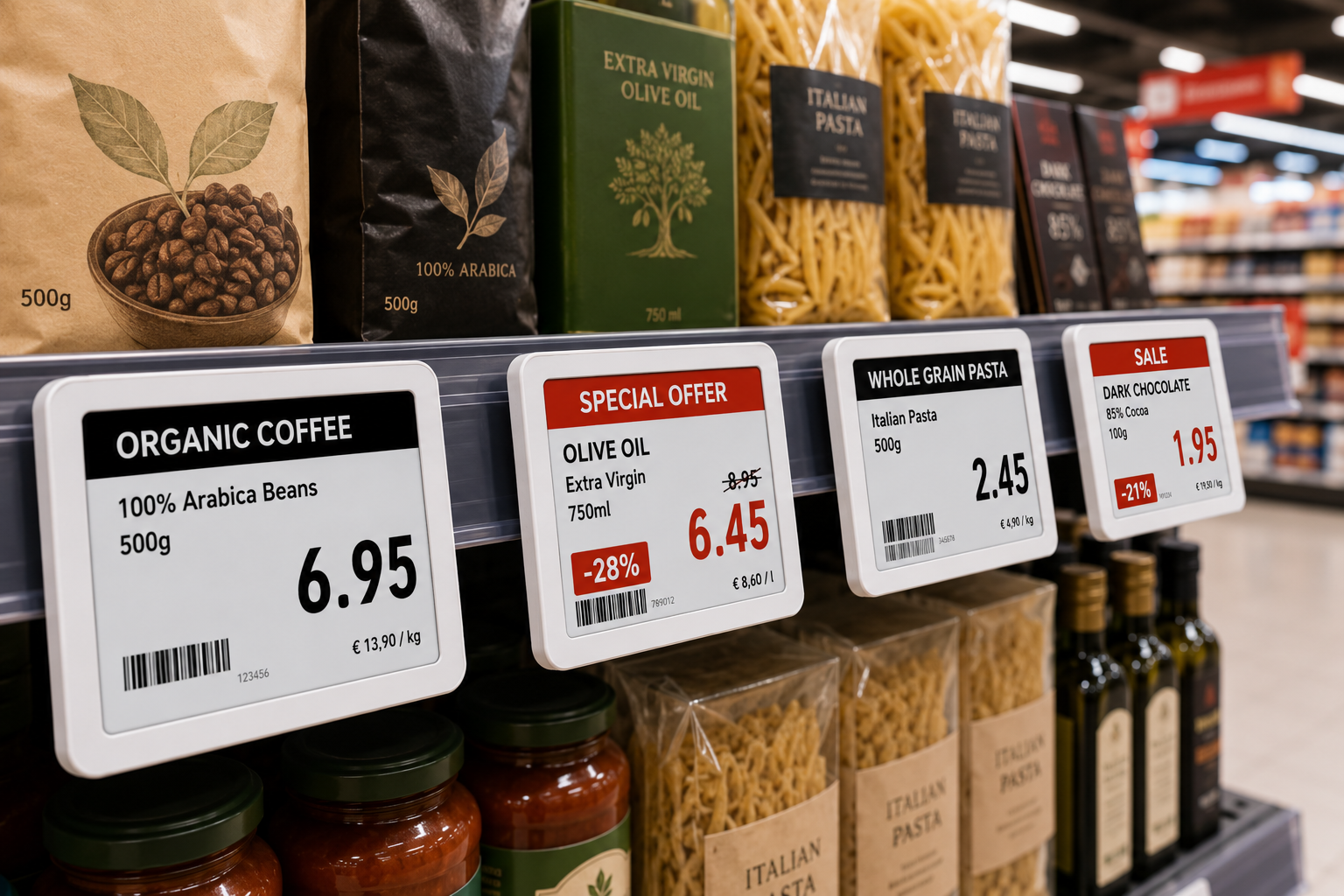
Quick answer: Black and white ESL displays are ideal for everyday pricing and product information, while black, white and red ESL displays help promotions, discounts and important messages stand out more clearly on the shelf.
What is an ESL display?
An ESL display is the visible screen on an Electronic Shelf Label. It shows information such as product price, product name, barcode, QR code, campaign message, unit price or stock-related details.
Most ESL displays use e-paper technology. E-paper is easy to read, has a paper-like appearance and uses very little power because the display normally only consumes energy when the image is updated.
Black and white ESL displays
Black and white ESL displays are the most common option for standard shelf pricing. They provide high contrast, strong readability and a clean professional appearance.
They are well suited for everyday price labels, product names, barcodes, QR codes and standard retail information where clarity and low power consumption are the main priorities.
Black, white and red ESL displays
Black, white and red ESL displays add a third color to the digital shelf label. The red color is used to highlight important information such as campaign prices, discounts, temporary offers or product alerts.
This makes tri-color ESL displays especially useful in retail environments where promotions and customer attention are important. The red color helps selected information stand out without requiring printed campaign labels.
How the red color is used in ESL labels
- Promotions: highlight campaign prices and temporary offers.
- Discounts: make reduced prices easier to notice.
- Clearance: draw attention to end-of-line or clearance items.
- Loyalty pricing: show member prices or special customer offers.
- Important information: mark warnings, stock messages or product notices.
- Visual shelf structure: create clearer differentiation between standard and campaign products.
Black and white vs black, white and red ESL displays
| Feature | Black & White ESL | Black, White & Red ESL |
| Best use | Everyday pricing | Promotions and highlights |
| Visual impact | Clean and simple | More attention-grabbing |
| Campaign use | Standard information | Excellent for discounts |
| Readability | Very high | Very high with added emphasis |
| Retail style | Standard shelf pricing | Campaign-focused stores |
Benefits of tri-color ESL displays
- Better visibility for campaign prices
- Clearer communication of discounts and offers
- Improved shelf presentation
- Reduced need for printed promotion labels
- Consistent digital campaign management
- Professional and modern store appearance
- Useful for retail automation and digital pricing
Does red affect ESL battery life?
The battery impact depends on the ESL model, display technology and update frequency. In most ESL systems, power consumption is mainly affected by how often the display is refreshed, not by the static image shown after the update.
For best battery performance, retailers should avoid unnecessary updates, use the correct label size and follow the manufacturer’s recommendations for display refreshes and campaign updates.
Which retailers benefit from black, white and red ESL?
Tri-color ESL displays are especially useful for retailers that run frequent campaigns, promotions or price changes. The red color makes it easier to draw attention to selected products without replacing paper signs.
- Supermarkets and grocery stores
- Electronics retailers
- Pharmacies
- DIY and hardware stores
- Convenience stores
- Fashion and lifestyle retail
- Retail chains with regular promotions
Choosing the right ESL display type
The best display type depends on the store layout, campaign strategy and type of product information shown on the shelf. Black and white ESL is often enough for standard pricing, while black, white and red ESL is valuable when visual highlighting is important.
Retailers should consider display size, readability, battery life, mounting options, POS integration and the need for promotional communication before selecting ESL display technology.
FAQ – Black, white and red ESL displays
What is a tri-color ESL display?
A tri-color ESL display is an Electronic Shelf Label display that can show black, white and one additional highlight color, usually red.
When should retailers choose black, white and red ESL displays?
Retailers should choose black, white and red ESL displays when they want to highlight promotions, discounts, loyalty prices or important product information more clearly.
Does the red color use more battery?
Battery usage depends mainly on update frequency and label design. The display typically consumes most power when the image refreshes, not while the information is static.
Can ESL displays show images or QR codes?
Many ESL displays can show simple graphics, barcodes and QR codes depending on resolution, display size and system support.
Need help choosing the right ESL display?
Contact Streckkods-Center for advice on Electronic Shelf Labels, black/white/red ESL displays, digital price labels and retail automation solutions.
Email: info@streckkodscenter.se
Phone: +46 (0)31-27 42 30