
1D vs 2D Barcode Scanners – Complete Business Guide
Choosing the right barcode scanner is essential for accurate scanning, faster workflows and reliable data capture in retail, warehouse, logistics and industrial environments.
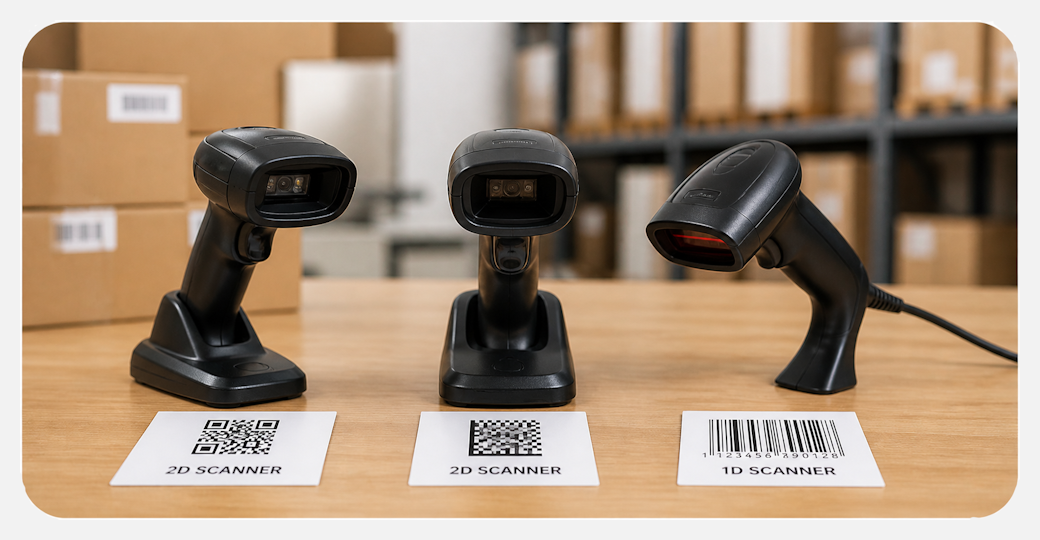
Barcode scanners are used to identify products, track inventory, process shipments and improve operational efficiency. One of the most important decisions is whether your business needs a 1D barcode scanner or a 2D barcode scanner. The right choice depends on barcode type, scanning environment, system requirements and future business needs.
Simple, fast and cost-effective for traditional linear barcodes.
Flexible, modern and future-proof for QR codes, Data Matrix and mobile screens.
What is a 1D barcode scanner?
A 1D barcode scanner reads traditional linear barcodes such as EAN, UPC and Code 128. These barcodes are widely used on product packaging, shelf labels, shipping labels and inventory labels.
1D scanners are often a good choice for businesses with simple scanning needs, fixed checkout points or basic inventory workflows where only standard barcodes are used.
What is a 2D barcode scanner?
A 2D barcode scanner can read both 1D barcodes and 2D codes such as QR codes and Data Matrix. This makes it more flexible for modern business systems and digital workflows.
2D scanners can also scan codes from mobile phones, tablets and computer screens. They are often recommended for retail, warehouse, logistics, healthcare and industrial applications where different barcode formats are used.
Key differences between 1D and 2D barcode scanners
When should you choose a 1D barcode scanner?
Choose a 1D scanner if your business only uses traditional linear barcodes and your scanning process is simple. This can be suitable for basic retail checkout, simple product identification and low-complexity inventory handling.
- You only scan standard barcodes
- You want a cost-effective solution
- You do not need QR code or screen scanning
- Your workflow is simple and stable
When should you choose a 2D barcode scanner?
Choose a 2D scanner if your business wants a more flexible and future-proof barcode scanning solution. 2D scanners are especially useful when you need to scan QR codes, Data Matrix codes, damaged labels or codes displayed on screens.
- You use QR codes or Data Matrix codes
- You scan from mobile screens
- You want one scanner for multiple barcode formats
- You work in warehouse, logistics, retail or industrial environments
Best barcode scanner for retail, warehouse and industry
Retail: A 2D barcode scanner is often the best choice for modern retail environments because it supports product barcodes, QR codes, loyalty apps and digital coupons.
Warehouse and logistics: Barcode scanning improves picking, packing, receiving and inventory control. A reliable barcode scanning solution helps reduce errors and improve traceability.
Industrial environments: 2D scanners are usually preferred because they handle difficult labels, compact codes and demanding work environments more effectively.
Mobile computers and barcode scanners
In warehouse and logistics workflows, barcode scanners are often combined with mobile computers to support real-time picking, stock control and order fulfillment.
Labels and label printers affect scanning performance
Even the best barcode scanner depends on readable labels. Poor print quality, damaged labels or the wrong label material can reduce scanning accuracy. For best results, combine your scanner with high-quality labels and reliable label printers.
Common mistakes when choosing a barcode scanner
- Choosing only based on price
- Buying a 1D scanner when QR codes may be needed later
- Ignoring scanning distance and working environment
- Using poor label quality
- Not checking system compatibility before purchase
FAQ – 1D vs 2D barcode scanners
Can a 2D barcode scanner read 1D barcodes?
Yes. A 2D barcode scanner can read both 1D barcodes and 2D codes.
Is a 2D scanner better than a 1D scanner?
In many business environments, yes. A 2D scanner is more flexible and supports more barcode formats.
Which scanner is best for warehouse use?
A 2D scanner is usually recommended because warehouse operations often require flexibility, speed and support for different code types.
Can barcode scanners read codes from mobile screens?
1D scanners usually cannot. 2D scanners are designed to read codes from printed labels and screens.
Contact Streckkods-Center for advice on barcode scanners for retail, warehouse, logistics and industry.
Email: info@streckkodscenter.se
Phone: +46 (0)31-27 42 30