- Unbeatable prices all year round
- Flat-rate shipping on many products.
- +46 (0)31-27 42 30
- info@streckkodscenter.se

Warehouse Barcode Scanners for Picking, Packing and Inventory Control
Choosing the right warehouse barcode scanner improves picking accuracy, goods receiving, inventory control, packing speed and overall logistics efficiency.
This guide helps you choose the best barcode scanner for warehouse operations, logistics, industrial scanning, WMS systems and high-volume barcode reading.
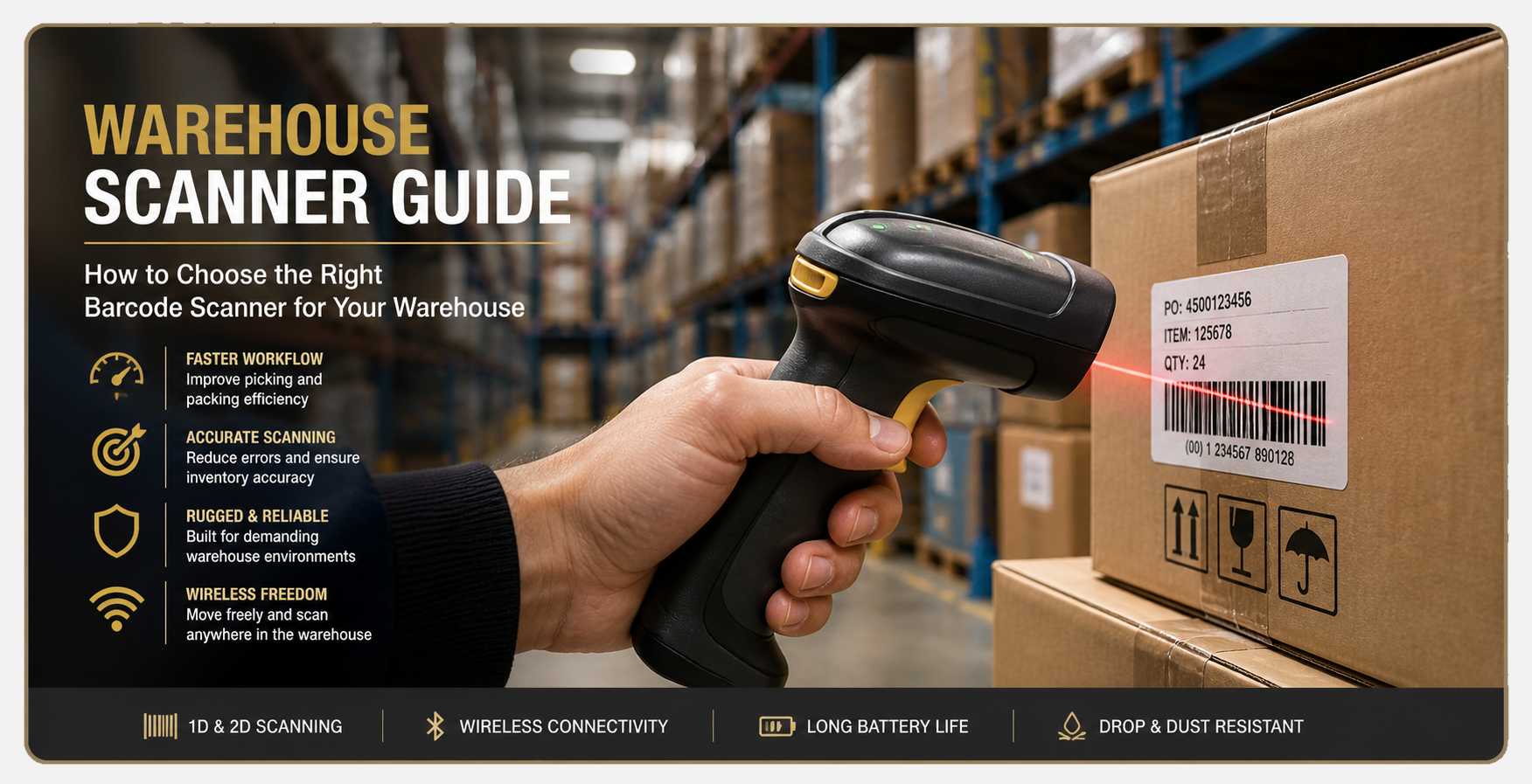
Quick answer: For most warehouse environments, a rugged wireless 2D barcode scanner is the best choice because it supports mobility, fast scanning, modern barcode formats and demanding daily use.
Why the right warehouse barcode scanner matters
Barcode scanning is a critical part of modern warehouse operations. The right scanner helps reduce picking errors, improve stock accuracy, speed up goods receiving and create a smoother workflow from inbound logistics to final shipment.
A scanner that is too slow, fragile or limited in barcode support can create bottlenecks, scanning errors and unnecessary downtime. That is why choosing the correct warehouse scanner is both a productivity and cost-control decision.
Common warehouse scanner applications
- Goods receiving: scan incoming cartons, pallets and product labels
- Order picking: verify items and reduce picking mistakes
- Packing stations: scan orders, shipping labels and documents
- Inventory control: update stock levels and perform cycle counts
- Pallet scanning: read labels from longer distances
- Warehouse location scanning: identify shelves, racks and storage zones
Types of barcode scanners for warehouses
Handheld barcode scanners
Handheld scanners are flexible and suitable for picking, packing, stock checks and everyday warehouse barcode scanning.
Wireless barcode scanners
Wireless scanners give operators freedom to move between aisles, pallets and workstations. They are ideal for warehouses where mobility is important.
Rugged industrial scanners
Rugged scanners are designed for drops, dust, vibration, cold storage and demanding industrial environments.
Long-range barcode scanners
Long-range scanners are useful for scanning pallet labels, high racks and barcode labels that are difficult to reach.
1D or 2D barcode scanner?
A 1D scanner reads traditional linear barcodes, while a 2D barcode scanner can read both 1D codes and 2D codes such as QR codes and Data Matrix.
For most modern warehouses, a 2D scanner is the safest long-term choice because it supports more barcode types, damaged labels and future system requirements.
Wireless vs wired warehouse scanners
Wireless barcode scanners are usually best for warehouse operations because they improve movement, reduce cable limitations and support faster workflows.
Wired scanners can still be a good option for fixed packing stations, desktop workstations or areas where the scanner always stays in one place.
Important features to compare
- Fast and accurate barcode reading
- Support for 1D and 2D barcodes
- Wireless connectivity such as Bluetooth or Wi-Fi
- Battery life for full-shift operation
- Drop resistance and IP protection
- Scanning range for shelves and pallets
- Compatibility with WMS, ERP and mobile devices
- Ergonomic design for long working days
Explore our range of barcode scanners for warehouse, retail, logistics and industrial use.
Compatibility with warehouse systems
Before choosing a scanner, make sure it works with your warehouse management system, ERP system, POS system, mobile computers or existing devices.
USB, Bluetooth, Wi-Fi and base station connections are common. The right setup depends on your scanning distance, workflow and system environment.
Durability in warehouse environments
Warehouse scanners often need to handle drops, dust, cold storage, forklift areas and continuous daily use. For demanding environments, choose a rugged scanner with strong drop resistance and suitable IP rating.
A more durable scanner may cost more upfront, but it can reduce downtime, replacement costs and operational interruptions over time.
Common mistakes when choosing a warehouse scanner
- Choosing only based on price
- Selecting a scanner with too short scanning range
- Ignoring drop resistance and IP rating
- Choosing 1D only when 2D support is needed
- Overlooking WMS, ERP or device compatibility
- Using office scanners in demanding warehouse environments
FAQ – Warehouse barcode scanners
What is the best barcode scanner for warehouse use?
A rugged wireless 2D barcode scanner is usually the best choice for modern warehouse operations because it combines durability, mobility and broad barcode support.
Do warehouses need wireless barcode scanners?
In most cases, yes. Wireless scanners improve mobility and make it easier to scan products, shelves, pallets and packing stations without cable limitations.
Should I choose a 1D or 2D scanner?
A 2D scanner is usually recommended because it can read both 1D barcodes and 2D codes such as QR codes and Data Matrix.
Can warehouse scanners read damaged barcodes?
High-quality 2D scanners can often read damaged, dirty or poorly printed barcodes better than basic barcode scanners.
Need help choosing the right warehouse scanner?
Contact Streckkods-Center for advice on barcode scanners for picking, packing, logistics, inventory control and industrial scanning.
Email: info@streckkodscenter.se
Phone: +46 (0)31-27 42 30