- Unbeatable prices all year round
- Flat-rate shipping on many products.
- +46 (0)31-27 42 30
- info@streckkodscenter.se

Wireless vs Wired Barcode Scanners – Which One Should You Choose?
Choosing between wireless and wired barcode scanners depends on your workflow, mobility needs, scanning distance and working environment.
Explore our full range of barcode scanners and find the right solution for retail, warehouse, logistics and industrial use.
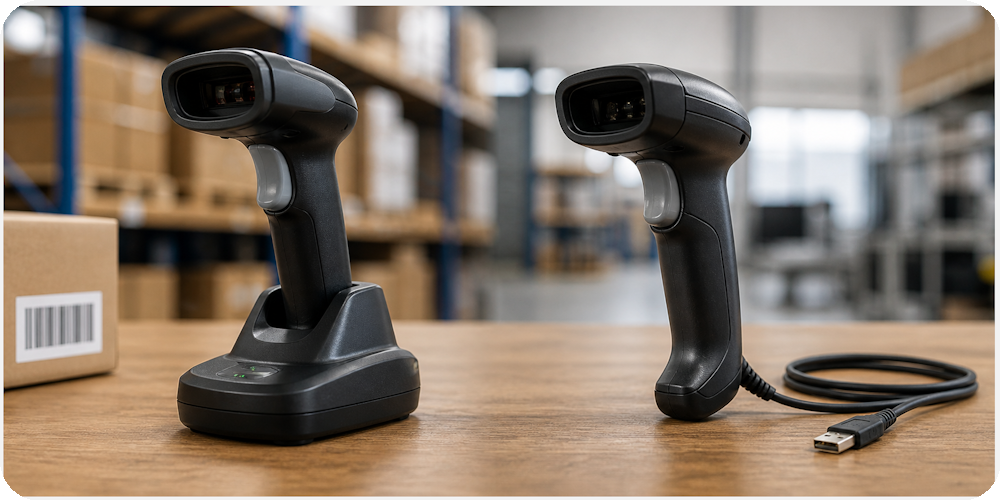
Quick tip: Use a wired scanner for fixed workstations and a wireless scanner for mobility across shelves, pallets and work zones.
What is a wired barcode scanner?
A wired barcode scanner connects via USB or cable to a POS system, computer or workstation. It offers stable performance, simple installation and requires no charging.
Wired scanners are ideal for checkout counters, office desks, packing stations and other fixed positions where the scanner is used in the same place throughout the day.
What is a wireless barcode scanner?
A wireless barcode scanner uses Bluetooth, radio connection or a base station to communicate without cables. This allows users to move freely while scanning products, shelves, cartons and pallets.
Wireless scanners are commonly used in warehouses, logistics operations, retail stores and industrial environments where mobility improves speed and efficiency.
Key differences between wired and wireless scanners
| Feature | Wired Scanner | Wireless Scanner |
|---|---|---|
| Mobility | Limited | High |
| Connection stability | High | Depends on environment |
| Battery charging | Not required | Required |
| Best for | Fixed workstations | Warehouse and logistics |
| Flexibility | Medium | High |
When to choose a wired barcode scanner
Choose a wired scanner when the scanning position is fixed and the workflow is predictable. Wired barcode scanners are reliable, easy to use and a strong choice for POS checkout, reception desks, office workstations and packing areas.
They are also suitable when you want minimal maintenance, no battery management and a stable connection to a computer or terminal.
- You work at a fixed workstation
- You want a simple plug-and-play solution
- You do not need long scanning range
- You want to avoid charging batteries
When to choose a wireless barcode scanner
Choose a wireless scanner when mobility is important. In warehouses, logistics and larger retail environments, wireless scanning allows employees to move between shelves, pallets, goods receiving and packing zones without being limited by cables.
Wireless barcode scanners can improve productivity when staff need to scan items in different locations or work across a larger area.
- You need mobility across shelves or pallets
- You work in warehouse or logistics
- You scan large or heavy items that cannot easily be moved
- You want more flexibility in daily workflows
Best choice for retail, warehouse and industry
Retail: Wired scanners are often ideal for checkout counters, while wireless barcode scanners are useful for stock checks, shelf work and flexible in-store tasks.
Warehouse: Wireless scanners are often the best option because employees need to scan products, cartons and pallets in different zones. For more advanced workflows, barcode scanners can also be combined with mobile computers.
Industry: The best choice depends on distance, environment and durability requirements. Industrial environments often need robust scanners that can handle dust, vibration and demanding workflows.
Labels, print quality and scanning accuracy
Scanner performance also depends on readable barcodes. Poor print quality, damaged labels or incorrect label material can reduce scanning accuracy. For the best result, combine your scanner with high-quality labels and reliable label printers.
Common mistakes when choosing wired or wireless scanners
- Choosing a wired scanner when employees need mobility
- Choosing wireless without considering battery routines
- Ignoring scanning distance and work environment
- Using poor-quality labels or unclear barcode prints
- Not checking system compatibility before purchase
FAQ – Wireless vs wired barcode scanners
Are wireless barcode scanners better?
Wireless scanners are better when mobility is required. For fixed workstations, wired scanners are often simpler and more cost-effective.
Are wired barcode scanners more reliable?
Wired scanners offer a stable connection and do not require charging, which makes them reliable for fixed positions.
What is the best scanner for warehouse use?
Wireless barcode scanners are usually the best option for warehouses because they allow staff to move freely across shelves, pallets and packing areas.
Do wireless barcode scanners work with inventory systems?
Yes, many wireless scanners can be connected to inventory systems, computers or mobile workflows depending on the model and setup.
Need help choosing the right barcode scanner?
Contact Streckkodscenter for expert advice on wired and wireless barcode scanners for retail, warehouse and logistics.
Email: info@streckkodscenter.se
Phone: +46 (0)31-27 42 30