- Unbeatable prices all year round
- Flat-rate shipping on many products.
- +46 (0)31-27 42 30
- info@streckkodscenter.se
How to Choose a Barcode Scanner for Business Use
Choosing the right barcode scanner improves speed, scanning accuracy and workflow efficiency in retail, warehouse, logistics and industrial environments.
This guide explains barcode types, scanning range, durability, connectivity and how to select the best barcode scanning solution for your business.
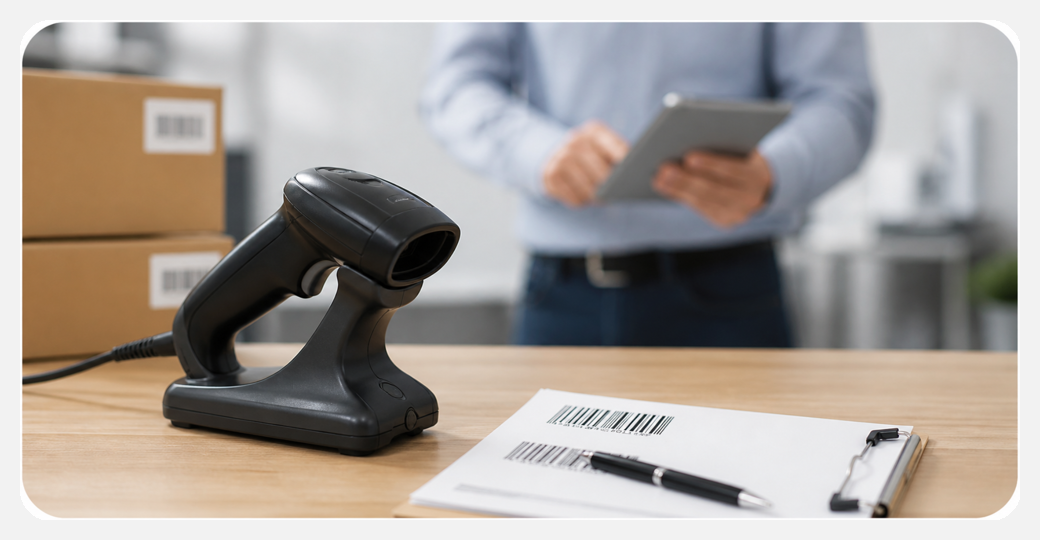
Quick tip: A 2D barcode scanner is usually the best long-term choice because it reads both traditional 1D barcodes and modern QR codes.
What is a barcode scanner?
A barcode scanner is used to capture barcode data quickly and accurately. It helps businesses register products, track inventory, process orders and reduce manual errors.
Barcode scanners are used in point-of-sale systems, warehouse picking, goods receiving, shipping, production and industrial traceability.
Modern businesses rely on barcode technology to improve inventory accuracy, reduce operational costs and increase workflow speed. In warehouse environments, barcode scanners help employees process shipments faster while reducing picking errors and improving traceability across the supply chain.
Retail businesses use barcode scanners together with POS systems to speed up checkout operations and improve customer service. Industrial operations often require rugged scanners designed to withstand dust, vibration and heavy daily usage.
1D vs 2D barcode scanners
A 1D barcode scanner reads traditional linear barcodes such as EAN, UPC and Code 128. These are common on product labels, shelf labels and shipping labels.
A 2D barcode scanner reads both 1D barcodes and advanced formats such as QR codes and Data Matrix. It can also scan codes from mobile screens, tablets and computers.
Many companies choose 2D barcode scanners because they provide better future flexibility and support modern digital workflows. QR codes are increasingly used in retail, ticketing, warehousing and manufacturing environments where additional information needs to be stored in compact formats.
| Feature | 1D | 2D |
|---|---|---|
| Traditional barcodes | ✔ | ✔ |
| QR codes | ✖ | ✔ |
| Data Matrix | ✖ | ✔ |
| Mobile screen scanning | ✖ | ✔ |
| Future flexibility | Limited | High |
Scanning distance and performance
Short-range barcode scanners are ideal for checkout counters, office environments and fixed workstations. Warehouse and logistics operations often require longer scanning distance for shelves, cartons, pallets and goods receiving.
Industrial barcode scanners are designed for high-performance scanning under demanding conditions. Many rugged models can read damaged, dirty or low-contrast labels, which is essential in warehouses and manufacturing facilities where labels may be exposed to dust, moisture or wear.
Wired vs wireless barcode scanners
Wired barcode scanners provide stable and reliable performance for fixed workstations, POS systems and packing desks.
Wireless barcode scanners offer more flexibility and mobility. They are often used in warehouses, retail stores and logistics environments where employees need to move freely while scanning.
Bluetooth barcode scanners have become increasingly popular because they improve ergonomics and mobility while reducing cable clutter in busy work environments.
Barcode scanners in warehouse and logistics
Barcode scanners are often used together with mobile computers and inventory systems to support real-time tracking, picking, packing and order fulfillment.
Warehouse management systems (WMS) and ERP integrations help businesses achieve better inventory visibility and operational control. Combining barcode scanners with mobile terminals creates faster workflows and more accurate inventory management.
Labels and printing for best scanning performance
High-quality labels and reliable label printers are essential for accurate barcode scanning and long-term readability.
Poor print quality can lead to scanning errors, delays and inefficient workflows. Businesses should choose durable labels and industrial-grade printing solutions when operating in demanding environments.
Common mistakes when choosing a barcode scanner
- Choosing a barcode scanner based only on price
- Buying a 1D scanner when QR codes may be needed later
- Ignoring scanning distance and working environment
- Using poor label quality
- Not checking system compatibility before purchase
FAQ – barcode scanners
What is the best barcode scanner for business use?
For most modern businesses, a 2D barcode scanner is the best choice because it can read both 1D barcodes and QR codes.
Can a 2D scanner read 1D barcodes?
Yes. A 2D barcode scanner can read both 1D and 2D barcode formats.
Which barcode scanner is best for warehouse use?
A wireless 2D scanner or a mobile computer is often recommended for warehouse workflows.
Can barcode scanners read codes from mobile screens?
2D barcode scanners are designed to read codes from printed labels and digital screens.
Need help choosing the right barcode scanner?
Contact Streckkodscenter for expert advice on barcode scanners for retail, warehouse, logistics and industry.
Email: info@streckkodscenter.se
Phone: +46 (0)31-27 42 30